

Yves here. Yours truly seems to be not alone in finding Andrew Korybko’s pieces to be frustrating, so I trust you will treat his latest as a critical thinking exercise. While he often marshals good information, he too often undermines that with simplistic assertions. A glaring one below is that the US would use its exploitation of Greenland to pay for Trump’s expansion of the military budget to $1.5 trillion.
As we explained in the context of the US’ wars against oil producing states, the US failed with Iraq, which then had the second biggest proven reserves, to extract its oil wealth. It looks set to fail again with Venezuela.
Some readers contested the report by former Ambassador to Saudi Arabia, Chas Freeman, that the US had not in fact gotten meaningful resource or financial benefits from its Iraq conquest by pointing to rules that required proceeds of Iraq oil sales to be deposited in US banks. Consistent with Freeman’s statement that China now controlled Iraq energy development, it has finessed payment via what amounts to barter, making direct investments in Iraq to compensate for oil deliveries. There may be other mechanisms to evade the US attempt to control payments, but this one, set forth by S&P, suffices to make Freeman’s case:
China has swooped into Iraq, unperturbed by an uncertain security environment and endemic corruption – and looking to meet its own domestic energy needs, analysts say.
PetroChina has taken over operations at Iraq’s major West Qurna 1 oil field – with a production capacity of 540,000 b/d – following ExxonMobil’s exit from the country.
CNPC, the largest Chinese investor in Iraq, holds stakes in Rumaila, Halfaya, Ahdab and West Qurna 1 fields, while CNOOC, Union, ZenHua and other minor players also have holdings in the country.
In Iraq’s latest upstream licensing round in May, Chinese companies were awarded all but three of the oil and gas blocks on offer.
Iraq and China signed in 2019 a controversial oil for reconstruction and investment deal. The 20-year contract includes a deal to supply Chinese companies with 100,000 b/d of crude in exchange for investment in infrastructure, with revenue from oil exports earmarked for funding development projects. Critics said the deal’s terms risked fueling corruption and waste and would leave Iraq in China’s debt.
And that’s before considering that any booty bennies are likely to go to Trump cronies as opposed to the public purse. From Greenland and the New Settler Colonialism: Network-State Geopolitics:
To put it simply, the tech section of capital that has so brazenly aligned itself with state power wants America’s national security state to, on their behalf, dispossess other peoples and even nation-states. That would permit the network-state oligarchs to establish semi-sovereign “company towns” that would extract and exploit whatever they will from the sites where they establish themselves.1 Greenland, dating back to 2018, was their ideal headquarters for utopia, the place they imagined unsettling so as to profit from carving up an already existing and governed place and render it into a frontier.
Snow Crash is looking more and more like an operating manual.
By Andrew Korybko, a Moscow-based American political analyst who specializes in the global systemic transition to multipolarity in the New Cold War. He has a PhD from MGIMO, which is under the umbrella of the Russian Foreign Ministry. Originally published at his website
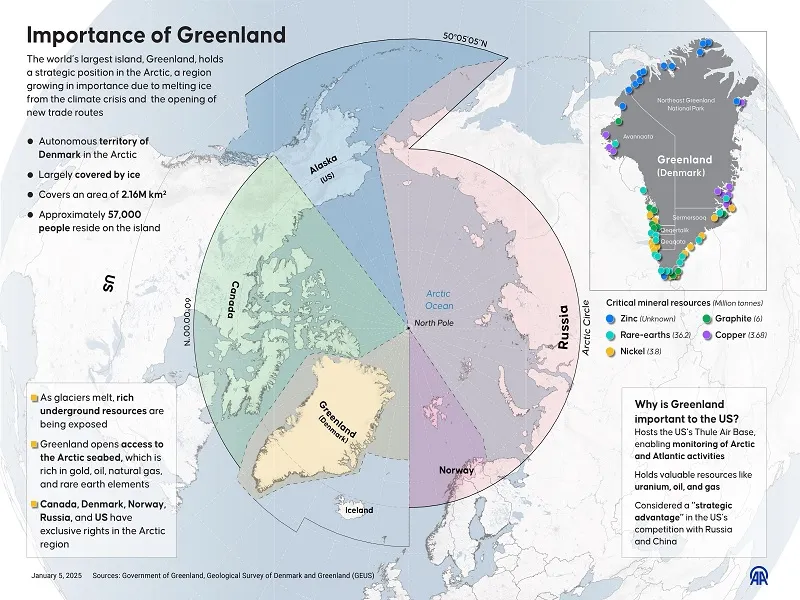
Building more facilities there to complement Pituffik Space Base would further the US’ “Golden Dome” missile defense plans for obtaining a strategic edge over Russia while extracting more critical minerals from there would reduce dependence on vulnerable Chinese supply chains.
Trump recently reaffirmed his intent to annex Greenland on the pretext that this would supposedly preempt China or Russia from invading NATO member Denmark’s autonomous territory. Many believe that his main motivation, however, is to obtain control over what’s estimated to be the world’s second-largest reserve of critical minerals. The Daily Mail then reported that the US itself is actually planning on invading the world’s largest island, not China or Russia, who Denmark doesn’t consider to pose a threat.
Amidst this news, Bloomberg reported that “UK, Germany Talk NATO Forces in Greenland to Calm US Threat” ostensibly with the intent of deterring the US even though it’s extremely unlikely that they’d fight it over Greenland just like it was earlier assessed that France wouldn’t either. Greenland is basically Trump’s for the taking if he really wants it since neither NATO nor the locals can stop it, the latter of whom have no realistic way to block it from extracting resources or building more military bases there.
Therein lies the goals that the US would advance since more facilities to complement Pituffik Space Base would further the US’ “Golden Dome” missile defense plans for obtaining a strategic edge over Russia while extracting more critical minerals would reduce dependence on vulnerable Chinese supply chains. Moreover, annexing Greenland would help build “Fortress America”, which is the “Trump Doctrine’s” plan as enshrined in the National Security Strategy for restoring US hegemony over the hemisphere.
Achieving this grand strategic goal would eventually help subsidize Trump’s proposed 50% increase in the defense budget to $1.5 trillion next year (and whatever more after), thus enabling the US to more muscularly contain China, and ensure that the US survives and even thrives in the (for now far-off) scenario that it’s expelled from the Eastern Hemisphere or withdraws from there. Greenland is the crown jewel of “Fortress America” for the aforesaid reasons so its annexation is imperative for the US.
That said, it’s also possible that some of Trump’s advisors convince him not to pursue since this might irreparably ruin ties with the EU and NATO, the first of whom the US envisages profiting tremendously from after last summer’s lopsided trade deal and the second of which it envisages leading Russia’s containment in Europe after the Ukrainian Conflict ends. Although the US would likely win a trade war with the EU, a protracted one could lead to less profits and more opportunities for China there.
As for NATO, without its full-fledged commitment to contain Russia after the Ukrainian Conflict ends, the US might balk at redeploying many of its forces from Europe to the Asia-Pacific for more muscularly containing China and thus undermine one of the tenets of the “Trump Doctrine”. Nevertheless, given the importance of the US market for the EU and most NATO members’ pathological fear of Russia, whatever damage the US’ potential annexation of Greenland inflicts on their ties should be quickly repaired.
For these reasons, it’s likely that the US will annex Greenland despite already enjoying full freedom of economic and military action there that neither China nor Russia ever will, in which case the US would remove any remaining doubt about its hegemonic intentions over its allies. Trump has never been deterred by concerns about hurting his counterparts’ feelings or their societies disliking the US, and the more that they talk about such consequences, the more he might want to do this just to spite them.
