

American militarism is usually discussed as something that happens “over there.” Foreign wars, overseas bases, expeditionary forces, and interventions conducted in the name of security or stability are treated as external acts, bounded by geography and time. What happens abroad, we are told, stays abroad. This framing is comforting—and false. Militarism is not simply a foreign policy choice. It is a governing habit. Techniques developed to manage distant populations, suppress resistance, and enforce order under conditions of asymmetry do not remain neatly contained overseas. They propagate. They evolve. And eventually, they come home.
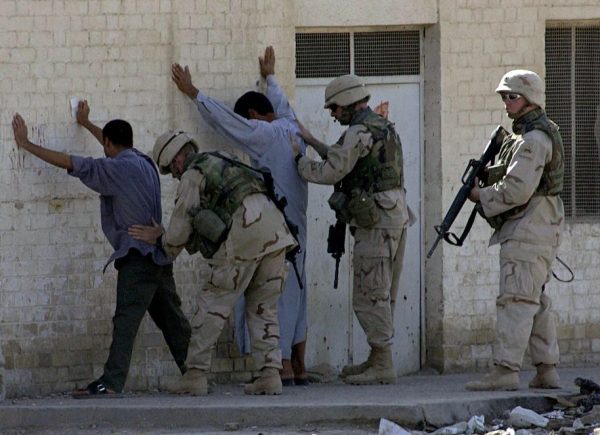
U.S. troops search Iraqi suspects circa 2003
Over the past two decades, the United States has experienced a steady inward movement of militarized doctrine, equipment, and operational mindset into domestic governance. This has not taken the form of tanks stationed on city streets or a formal declaration of martial law. Instead, it has been quieter, bureaucratic, and therefore more insidious. Emergency authorities have become routine tools. Political dissent has been reframed as a security problem. Civil administration increasingly relies on force structures designed for war.
The growing impact of militarized governance in U.S. domestic affairs is neither sudden nor episodic. It has become increasingly evident across immigration enforcement, protest management, and everyday law enforcement, reshaping how political problems are addressed at home.
Immigration: border policy as counterinsurgency
Nowhere is the inward migration of militarism clearer than in U.S. immigration policy. The southern border is no longer treated primarily as a site of civil administration and legal adjudication. It has been recast as a contested security zone requiring deterrence, domination, and force projection.
Troops at the southern border wall with Defense Secretary Hegseth
State and federal deployments alike increasingly resemble military operations. Armed National Guard patrols, fortified barriers, aerial surveillance, and the language of “invasion” and “territorial defense” have displaced older administrative frameworks. These measures are justified as temporary responses to crisis, yet they persist year after year, regardless of political party or migration cycle.
At the federal level, the transformation of immigration enforcement after 9/11 was decisive. Agencies once oriented toward civil law were absorbed into a security apparatus whose primary reference points are counterterrorism and border defense. The result was not merely organizational reshuffling, but doctrinal change. Migrants came to be treated less as civilians subject to administrative law and more as potential hostile actors within a security theater.
Detention centers, expedited removal, militarized raids, and highly visible force are not systems designed to resolve individual cases fairly. They are systems designed to shape population behavior through intimidation and deterrence. This logic closely mirrors counterinsurgency doctrine abroad, where compliance is sought not through legitimacy but through the demonstration of overwhelming capacity. The striking fact is not that force is occasionally used, but that military-style deterrence has become the default grammar of immigration policy, even as it consistently fails to address the structural drivers of migration.
Dissent: protest as a security problem
The militarization of dissent followed a similar path.
During the nationwide protests of 2020, police departments across the country deployed armored vehicles, military-grade weapons, riot gear, and battlefield tactics against civilian demonstrators. Curfews were imposed en masse. Journalists were detained or injured. Mass arrests were justified under emergency powers that treated protest itself as a form of instability requiring suppression.
In Washington, D.C., federal agencies joined local law enforcement in confronting demonstrators. Tactical units trained for high-risk operations were deployed against civilian crowds. The distinction between law enforcement and domestic military presence blurred, not because it was formally erased, but because operational posture no longer reflected civic management.
This response was not limited to moments of violence. Even peaceful protests were frequently met with preemptive force, justified by the assumption of potential escalation. This mirrors the logic of occupation abroad: treat the population as a latent threat, and escalation becomes self-justifying. Language again matters. Protesters are increasingly described using security terminology, such as “extremists,” “agitators,” and “threat actors, ” that collapses political dissent into security risk management. The effect is not the prohibition of protest, but its containment within a force-dominated environment that raises its cost and narrows its practical space.
Law enforcement: the normalization of the warrior model
Everyday policing provides perhaps the clearest evidence that militarism has come home.For decades, federal programs have transferred surplus military equipment to local police departments, including armored vehicles, assault weapons, and battlefield technology. Defenders argue that such equipment is rarely used. But frequency is not the point. Presence shapes posture.Training has followed equipment. Police are increasingly trained in “warrior” models that emphasize threat dominance, officer survival, and rapid escalation.
De-escalation and civic engagement are subordinated to tactical control. Encounters are framed as potentially lethal engagements rather than civil interactions. The consequences are visible in routine policing: no-knock raids for low-level warrants, overwhelming force for administrative actions, and rapid escalation in encounters that once would have been resolved verbally. When mistakes occur, they are treated as tragic but inevitable outcomes of a dangerous environment—an environment these tactics help create. When law enforcement adopts the tools and mindset of military units, it inevitably adopts their assumptions: that safety comes from superiority, that uncertainty must be met with force, and that errors are acceptable collateral.
The inward migration of militarized governance has not been limited to force and equipment; it is also manifested in the domestic adaptation of intelligence systems originally designed for foreign counterterrorism operations.
Surveillance: hi-tech military intelligence tools applied domestically
Alongside visible militarization, a quieter transformation has taken place through the domestic adoption of surveillance technologies originally developed for counterterrorism and overseas military operations. These systems were designed to operate in environments where the population itself was treated as a potential threat, and where persistent monitoring was justified by force-protection logic.
After 9/11, many of these technologies migrated into domestic use with remarkably little public debate. Tools developed for foreign theaters—such as mass metadata analysis, geolocation tracking, social network mapping, and wide-area aerial surveillance—were repurposed for domestic law enforcement and intelligence functions. The justification was continuity of threat: terrorism was no longer “over there,” but embedded within civilian life.
Programs revealed through whistleblowers and subsequent reporting demonstrated how battlefield-style intelligence architectures had been adapted for domestic governance. Rather than targeting known suspects, these systems prioritize pattern detection across populations, treating association, movement, and communication as signals of potential risk rather than protected civic behavior.This approach mirrors counterinsurgency logic, in which intelligence dominance substitutes for political legitimacy.
The result is a form of militarization that operates without uniforms or armored vehicles. Surveillance becomes a primary instrument of control, enabling preemptive intervention while insulating decision-makers from public accountability. When combined with militarized policing, intelligence-led governance collapses the distinction between investigation and threat management.
This shift does not require overt repression to reshape civic life. It is sufficient that individuals and organizations understand they are being persistently observed, profiled, and assessed. In this environment, political activity itself becomes a data-generating risk factor rather than a protected civic act.
Political organizations as security targets
More recently, militarized logic has extended beyond crowds and routine policing into the treatment of organized political activity itself. The FBI raid on the Uhuru Movement’s headquarters in 2022 provides a revealing case. Conducted under a counterintelligence framework aimed at foreign influence, the operation reportedly involved armored vehicles and the use of stun grenades during the execution of search warrants against a domestic political organization with no known history of armed activity.
2022 Uhuru raid in St. Petersburg, FL
The Uhuru raid illustrates what happens when militarized surveillance and militarized force converge in a domestic political context. Whatever the legal merits of the investigation, the operational posture is telling. Tactics developed for high-risk counterterrorism were applied to a domestic civilian political group. Political advocacy was evaluated through a threat-based security lens rather than through civil or criminal law alone. The significance of this episode lies not in its target, but in its method. When overwhelming force becomes the default response to political activity framed as a security concern, the boundary between law enforcement and military-style threat neutralization begins to erode, and this endangers democracy.
This Is not an accident
None of these developments requires a conspiracy to explain. Institutional incentives are sufficient. Military approaches promise clarity in complex situations. They reduce political and social problems to security problems, where force can substitute for legitimacy. They attract funding, simplify decision-making, and provide bureaucratic insulation when outcomes are poor. Once adopted, they persist because they are self-reinforcing. Each deployment normalizes the next. Political failure also plays a role. Where civilian institutions prove incapable of addressing inequality, migration, or dissent, force becomes the fallback. Militarism fills the vacuum left by the erosion of political solutions.
Conclusion: the cost of bringing war home
The danger of militarism is not that the United States will abruptly abandon democratic forms; it is that militarized governance will slowly displace the civil norms on which those forms depend. Militarism does not announce itself as the enemy of liberty. It presents itself as order, efficiency, and safety. But over time, it corrodes the very society it claims to protect. Politics becomes administration by force. Dissent becomes instability. Civil rights become conditional. A society that increasingly governs itself through the logic of war will eventually be unable to govern itself any other way.
