

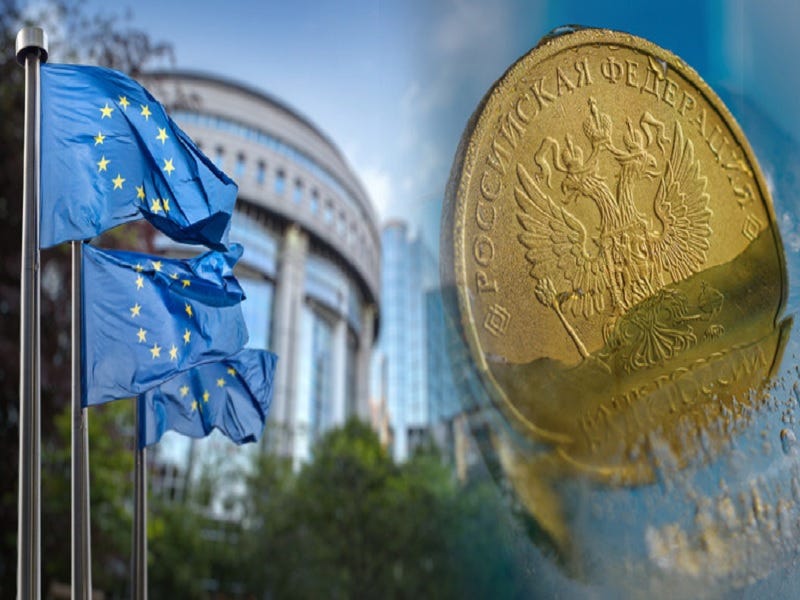
Yves here. Korybko claims that the EU seeking to tighten its control over Russian seized assets is the product of the US putting forward other uses for them its 28 point peace plan. While that ia a significant motive, it is far from the only one.
It is true that the leak of the 28 item outline did appear to have a galvanizing effect on European leaders and gave them a talking point to help advance their nefarious and self-destructive scheme. However, Ursuala von de Leyen has been rabbiting on about “seize not freeze” for well over a year. And anyone with an operating brain cell would recognize that the US and Russia are not even remotely close to consummating an agreement. The US can’t even bring itself to return Russia’s expropriated diplomatic property in the States, FFS. How can they be trusted to get anything done in light of that? And the European manufactured urgency is further silly in light of the fact that Russia has zero reason to let the US grift from managing Russian assets for a Ukraine restoration project controlled by the US.
So other motivations include:
Yet more power-grabbing by Queen Ursula and the Commission
Providing another news hook for more Russia scare-mongering to shore up unpopular leaders like Kier Starmer, Emmanuel Macron, and Freidrich Merz
Shoring up the idea that Ukraine is somehow a viable force, which is consistent with the fantasy that Russia is taking such large battlefield losses that if Ukraine can hold out just a bit longer, Russia will fold (or better yet, the citizenry will rise up in revolt against Putin, enabling the sought-after break up and looting of Russia).
Using military Keynesianism to combat Europe’s falling competitive position and economic stagnation, a Lord Robert Skidelsky contends in a new article. A key section:
The rearmament momentum in Europe has drivers that extend well beyond the stated security rationale of countering Russia. A growing strand of European policy thinking suggests that the rearmament drive serves a second, less openly acknowledged purpose. As Berg and Meyers (CER, 2025) argue, much of the EU’s rearmament agenda is being justified through the language of security, yet in practice functions as an attempt to revive Europe’s weak productivity and failing industrial base—an industrial strategy masquerading as a defence imperative, in effect a post-pandemic and post-stagnation strategy of military Keynesianism. From this perspective, the insistence on an existential Russian threat functions not simply as a strategic assessment but as political cover for a massive industrial mobilisation that EU leaders hope will restore European economic competitiveness.
I agree that Europe needs new sources of growth, but the attempt to smuggle industrial policy in under the banner of a war footing—by cultivating fear and exaggerating threats—is neither honest nor acceptable. Manufacturing a warlike mindset to legitimise economic renewal may be politically convenient, but it corrodes democratic debate and risks locking Europe into a perpetual militarisation that has little to do with Europe’s real economic challenges.
By Andrew Korybko, a Moscow-based American political analyst who specializes in the global systemic transition to multipolarity in the New Cold War. He has a PhD from MGIMO, which is under the umbrella of the Russian Foreign Ministry. Originally published at his website
The real purpose might be to prevent the US from reaching a deal with Russia per point 14 of its leaked 28-point peace framework to invest a significant sum of its (by-then former) adversary’s EU-seized assets into joint projects, likely energy and rare earths, after the conflict ends.
Russia condemned the EU’s recent decision to indefinitely immobilize its seized assets, the special procedure for which scandalously circumvented member states’ veto power in an effort to prevent Hungary and Slovakia from stopping them. This move might precede the bloc either confiscating some of these funds and giving them to Ukraine and/or using them as collateral for a loan to that country. The official purpose would be to fund more arms purchases and/or assist with post-conflict reconstruction.
The first goal won’t lead Ukraine inflicting the EU’s desired strategic defeat of Russia while the second requires much more than just Russia’s seized assets to complete. Regardless of the official purpose, confiscating Russia’s assets or using them as collateral for a loan to Ukraine would inflict irreparable harm to the EU’s financial reputation. Foreign investors might be spooked into fearing that their assets are no longer safe and could thus pull them from EU banks and not deposit future ones there either.
The bloc might therefore ultimately lose hundreds of billions of dollars, perhaps upwards of a trillion or even more with time, all ostensibly for Ukraine’s sake even though it’s impossible for that country to strategically defeat Russia or be reconstructed entirely with its foe’s stolen funds. There are accordingly reasonable grounds for suspecting that the EU has ulterior motives in mind for seriously contemplating this and that its new policy towards Russia’s seized assets isn’t about helping Ukraine.
The real purpose might be to prevent the US from reaching a deal with Russia per point 14 of its leaked 28-point Russian-Ukrainian peace deal framework to invest a significant sum of its (by-then former) adversary’s EU-seized assets into joint projects, likely energy and rare earths, after the conflict ends. Such an arrangement could set those two on the path to revolutionize the global economic architecture as explained here and consequently accelerate the EU’s growing irrelevance therein.
With a view towards averting that scenario, the EU might have thus decided to indefinitely immobilize Russia’s seized assets as the first step towards “legally” asserting quasi-ownership over them, after which it might then either confiscate them and/or use them as collateral for a loan to Ukraine. The special procedure that was employed for circumventing member states’ veto power bodes ill for Hungary, Slovakia, and others concerned countries’ ability to veto the aforesaid moves that might soon follow.
The abovementioned plot could be preempted by Russia transferring legal ownership of its EU-seized assets to the US as was proposed here in April, but this is only possible if Russia and the US reach a deal on using these funds for financing joint projects, which requires rock-solid trust that doesn’t yet exist. Tangible progress on reaching a NATO-Russian Non-Aggression Pact, or at least the US managing Turkish-Russian tensions in Central Asia, could bring this about and thus ensure that these funds aren’t all stolen.
If the US obtains legal ownership of Russia’s seized assets, then Trump would have the pretext for demanding their transfer to the US under pain of sanctions, which is the only way to guarantee that they’re not given to Ukraine or remain indefinitely immobilized. The EU must therefore decide whether it’s worth the gargantuan cost of destroying its financial reputation just to impede a Russian-US rapprochement, but if it goes through with this, then those two might team up against it afterwards.
