

The Federal Reserve raised its economic growth forecast for 2026, and Wall Street expects another strong year for the U.S. stock market.
The S&P 500 (^GSPC 1.07%) crashed after President Donald Trump announced severe tariffs in April. The index has since staged an incredible recovery, adding 16% year to date. But the Trump administration’s trade policies have left the economy on shaky ground. Hiring has slowed sharply, and unemployment recently hit a four-year high.
Labor market weakness prompted the Federal Reserve to cut interest rates at the December meeting. But that headline overshadowed a more important development. Policymakers raised their economic growth forecast for 2026, such that gross domestic product (GDP) is now projected to increase 2.3% next year, up from the previously forecasted 1.8%.
Strong GDP growth often coincides with strong returns in the stock market, so the Federal Reserve’s increased confidence in the economy is good news for investors. Indeed, while the S&P 500 has often delivered muted returns after interest rate cuts, Wall Street expects another strong performance in 2026 as artificial intelligence spending supports the economy.
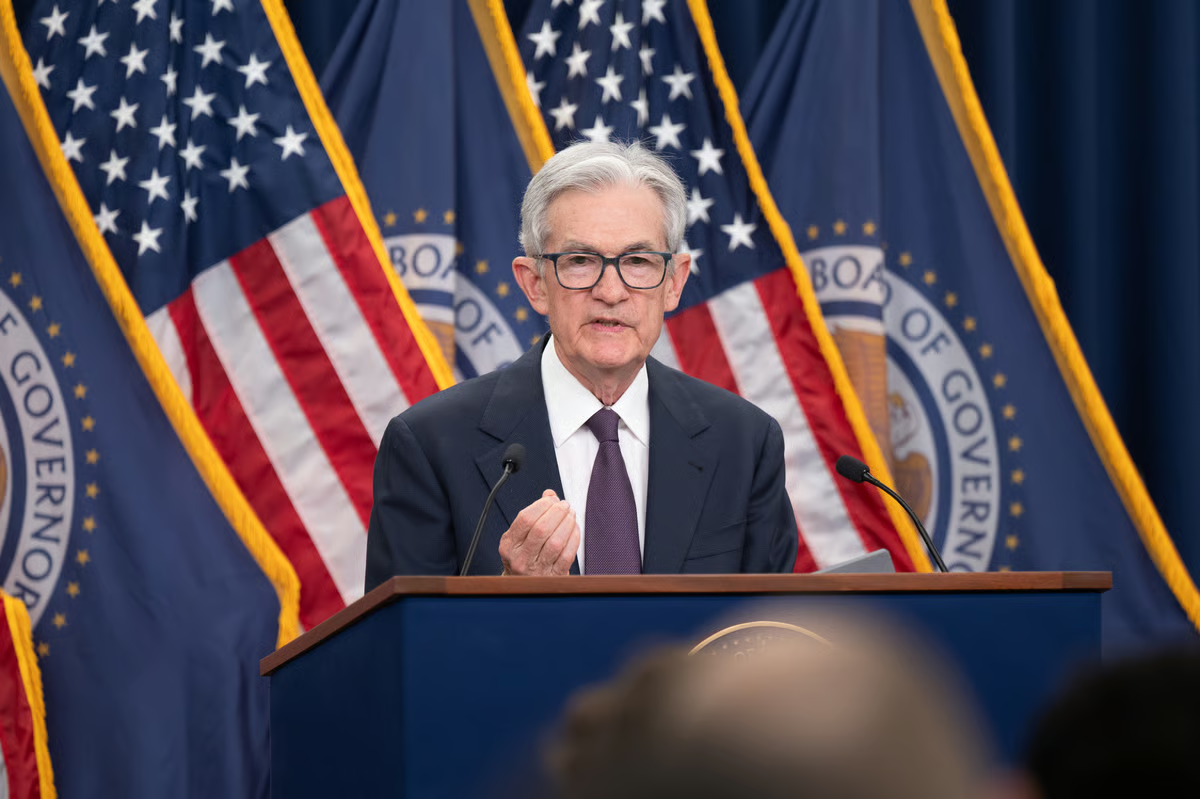
Image source: Official Federal Reserve Photo.
The S&P 500 has historically delivered muted returns following interest rate cuts
The market gets excited about interest rate cuts because they stimulate the economy by lowering borrowing costs. But that excitement is somewhat nonsensical. Rate cuts are effectively medicine for the economy, so hoping the Federal Reserve lowers interest rates is essentially hoping the economy is sick enough to need medicine.
Indeed, policymakers have lowered the benchmark federal funds rate 58 times since 1990, and the S&P 500 has returned an average of 3% during the next year. That is well below the index’s average return of about 10% annually over long periods.
Such an outcome is entirely possible in the next year, especially because stocks are historically expensive. The S&P 500 trades at 22.5 times forward earnings, well above the five-year average of 20 and the 10-year average of 18.7, according to FactSet Research.
Wall Street expects another strong performance from the stock market in 2026
In total, Wall Street analysts have over 12,600 ratings on different stocks in the S&P 500. FactSet Research combines the median target for every stock to create a bottom-up forecast for the entire index. The S&P 500 is projected to reach 7,968 by December 2026, which implies about 17% upside from its current level of 6,827.
Underpinning that confidence is the expectation that earnings growth will accelerate, led by particularly strong results from stocks in the information technology and materials sectors. In total, S&P 500 earnings are on pace to increase 13.1% in 2025, but analysts expect earnings to grow 14.7% in 2026.
Factors contributing to that optimistic outlook include a reduction in corporate taxes due to new deductions for research and development (R&D) spending and equipment purchases. Artificial intelligence (AI) should also contribute to strong earnings growth by boosting both revenue for companies that sell AI products and operating margins for companies that use AI products.
However, there are risks to the downside. Most experts think President Trump’s tariffs will hinder economic growth, but the extent to which they will hurt the economy is difficult to quantify due to their unprecedented scope and severity. However, the president’s trade war has already coincided with increased unemployment, slower hiring, and a sharp reduction in consumer sentiment.
If those trends persist, S&P 500 earnings could grow more slowly than expected next year. The stock market is already primed for a drawdown due to its elevated valuation, so anything that raises questions about the health of the economy — such as slower-than-expected earnings growth — could lead to a sharp correction or even a bear market.
