

Let’s briefly recap what’s going on at the global level before turning to the breakdown in the US food system. As the Trump administration’s recent solution to higher beef prices (just import more!) shows, Washington’s fallback option when the “world’s breadbasket” struggles is to look abroad. Problem there is the US is doing everything it can to disrupt the global system as well.
Through its conflicts with Iran and Russia, the US has achieved the following:
- Massive destruction of fertilizer supplies.
- Natural gas shortages on which fertilizer production relies.
- Diesel shortages, which means reduced harvests.
Yves has covered this on a daily basis in her Iran war updates and warned early on that reduced fertilizer supplies and high energy costs, particularly of diesel, would translate into higher food costs, which is happening.
Keep in mind, we don’t know what other crazy schemes the empire might have up its sleeve to make the situation even worse. Who thought they were crazy enough to go this far in the two main conflicts it’s currently engaged in?
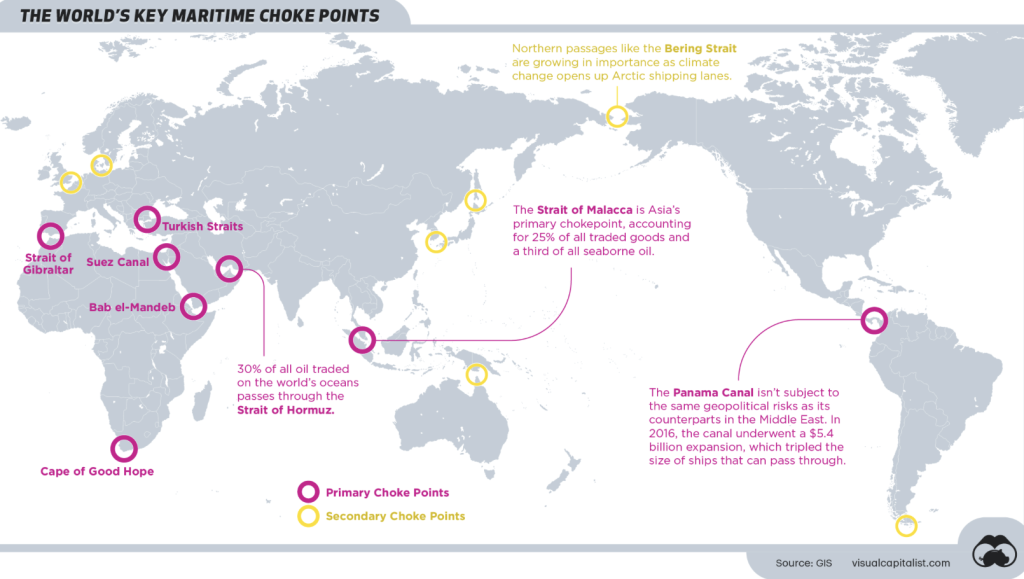
One logical spot to look for more escalation would be at some of Washington’s favorite targets—and ones that would make the situation even worse. The throttling of global chokepoints and seaborne trade is making the transport of export of agricultural products more expensive and challenging.
In only a few short years, the US has managed to slow traffic in nearly all of the following primary chokepoints, and even secondary ones are beginning to starting to look pretty iffy if they’re not already a geopolitical flashpoint already:
It would not be surprising if there were more proxy containment and blockade efforts with a global increase of attacks on commercial shipping.
With this, comes food as part of the proxy and economic attritional warfare the US is waging.
All of this means higher prices. The US and Europe seem to believe they’ll simply outbid poorer countries, and they likely will, although they’re unlikely to get off that easy. Perhaps the elites in what’s referred to as “The West” believe their police-surveillance states are advanced enough to handle any resulting unrest. Elsewhere the risk rises of famine, destabilization, mass migration, and more conflict.
Is this shock therapy on a civilizational scale or just massive incompetence? The US will look lend a little plundering “help” to those that submit ala Pakistan’s $10 billion currency stabilization request following its role in “peace” talks with Iran. Others will no doubt be targeted for regime change.
***
How about back in the good ol’ US of A?
One would imagine the country, formerly known as the world’s breadbasket, is doing all it can to support its agriculture industry to make sure the homeland is well fed and secure, right? Right?
Not exactly. Food insecurity is rising quickly as prices rise and assistance is cut—again. Foodborne illnesses are through the roof, the cattle industry is in free fall, and data centers are prioritized over agriculture. Let’s take a look at what’s going on inside the US, which is the second largest importer of food items in the world, behind only China.
The Big Beautiful Bill is doing its work helping to cull the herd:
Source: Stephen Seemler
And just in case there are any bread riots, its worth noting that the state used the “savings” to beef up the police state. From Stephen Semler:
It’s fitting that the same bill that created the food assistance cliff also sent ICE $75 billion — more money than the agency has shown it knows what to do with…Food aid was effectively taken from the needy and given to ICE.
Trump’s effective booting of millions off of food assistance came on the heels of Biden’s reduction of monthly benefits by a third! Every congressional Democrat voted for it except Alexandria Ocasio-Cortez. Who says reaching across the aisle is dead?
Unsurprisingly, food insecurity is rising quickly, and this is before we even hit some of the grain, diesel, and fertilizer cliffs. El Nino would also like to have a word.
Source: Stephen Semler
This in the “richest country in the world”, as Trump called it when he lambasted critics of his tariffs as “fools.” About those tariffs…
Well, as fate would have it, Trump was forced to issue rebates. So the companies that simply raised prices to offset the tariffs/passed on the cost dollar-for-dollar to working class Americans then got rebate checks! If you’re still waiting for yours, you’re not alone. I believe Costco (and maybe a few others?) did pass on rebates to members.
Food prices, of course, are not going down even after companies received the refunds. The biggest reason why is they simply don’t want to as profits soar to new heights. The chaos the US has unleashed in global supply chains in the Middle East, Black Sea, and other chokepoints is another reason.
Global warming climate events, infectious diseases, and foodborne illnesses are also wreaking havoc, but the US has decided to embrace all as either harmless or not worth the hassle.
Not only did the Trump administration scale further back food inspections that were already bare bone (again, bipartisanship!) ahead of the recent cyclospora outbreak that has sickened thousands across multiple states, but it is continuing to do so. According to Politico:
Two of the three projects that represent nearly all of the Agriculture Department’s study of the parasite were defunded by Congress earlier this year, according to the agency. The third is slated to move from Maryland to Iowa this fall as part of a sweeping USDA reorganization. Even though that project still has money, every scientist working on the parasite has declined to relocate…
And corruption delayed action and unleashed more confusion as the outbreak unfolded, as reported by the Wall Street Journal:
Taylor Farms sought out the White House after company executives felt they hadn’t gotten enough clarity from the FDA on the evidence behind a potential recall and the scope of it, according to a person familiar with the situation.
Health and Human Services Department spokeswoman Emily Hilliard said the FDA presented Taylor Farms with substantial evidence connecting its products to the outbreak and engaged in extensive discussions with the company.
The call was facilitated by Trent Morse, a lobbyist who previously worked as a senior White House personnel official and is now working for Taylor Farms, according to a person familiar with the outreach.
Foodborne illnesses not only sicken—and kill—people, but recalls can cost companies a pretty penny as can compensation to victims. These costs ultimately get passed onto consumers, and any related shortages can also drive sticker shock.
Trump, as always, is acting as an accelerant on an already-raging fire. According to Wired, the Food and Drug Administration lists more than 12,800 illnesses tied to foodborne outbreaks in 2026, already far surpassing the number it has identified in any year since 2020. The growing number is the result of underfunding food safety systems, turning much of the responsibility over to companies, and junk public health infrastructure—longterm trends the Trump administration has embraced.
The same is true of the cattle industry, already in dire straits due to concentration of packers, which solidified their control over the available fed cattle supply by shuttering several plants earlier this year.
Now along comes screwworm, likely aided by DOGE. From Moneywise:
According to the National Sustainable Agriculture Coalition (NSAC) (8), the USDA lost approximately 20,000 employees from January 2025 to January 2026. During that time period, the USDA’s Animal Plant and Health Inspection Service (APHIS) lost 2,009 employees, which was 23% of the service. A June 10 report from The Hill stated that the Trump administration “cut funding at USDA for programs that were specifically targeted to monitoring and responding to New World screwworm.
Shockingly, the US Department of Agriculture reopened some Mexican cattle imports in August, despite the screwworm in Mexico. Does Big Ag even care?
Even before the arrival of screwworm, beef production from domestic cattle continued to decline while imports continued to increase. From Morning Ag Clips:
Imports in the first half of 2026 represented nearly 30% of the beef produced from domestic cattle. America’s dependency on foreign beef has never been greater, and this foreign beef is not only displacing domestic production, but it is also disincentivizing domestic herd expansion.
Trump now sticks the knife in with his plan to import a whole lot of beef ostensibly to lower consumer costs—although there’s no reason to believe that will happen. Rancher groups are understandably furious.
“You don’t put America first by putting U.S. cattle producers last. This move will weaken our markets and gamble with food safety in the process,” said United States Cattlemen’s Association President Justin Tupper.
Justin, that—along with providing multinational beef packers and retailers with cheaper supplies—just might be the point.
A fun aside: investigations show that horse and other animals make their way into the sprawling global meat supply chain. That surely helps keeps costs down and profits up, as well.
Let’s not forget data center developers encroaching on agricultural land—and power and water. The AI craze is adding to the already-abundant challenges of being a small scale farmer, and will help to increase agriculture concentration.
As always, trying to make sense of such inhumanity can be a fool’s errand, but let’s give it a shot anyways.
Who Profits?
Defense companies and police/surveillance since collapsing food systems will destabilize the US and the world?
Maybe ‘Zuck’ plans to scale up his vertically integrated cattle hobby?
More seriously, it’s clear that in some cases it’s Big Ag. Bringing in more beef imports, for example, helps its margins. We’ve seen the Trump administration go to this playbook before to help oligarchs capitalize off of crises—oftentimes of the self-created variety. When the administration’s deportations began to pick up steam, stories of farm labor shortages began to pop up from around the country. The idea that Americans were going to take over those jobs due to new Medicaid work requirements was always ridiculous (most adults enrolled in the Medicaid program who can work already do, those who don’t are usually unable to do so due to disabilities or caregiving obligations, and few people enrolled in Medicaid live close enough to a farm to work at one). So what happened? The administration went after undocumented and those on humanitarian parole and temporary protected status, many of whom had established lives here and even joined unions and clawed back a little bit of power at the workplace.
Now to make up for the unsurprising shortfall of labor due to deportations, the administration has predictably expanded the guest worker program while also cutting the amount they must be paid. These workers’ ability to be in the country is directly tied to employer, they can’t unionize, and are more exploitable. Was it the result of a harebrained, yet genuine effort to get American-born workers out into the fields or was this the goal along? Trump’s longtime affinity for guest workers at his own properties, as well as his ramping up of the program during his first administration points to the latter.
And so while it’s almost certain that a mix incompetence, oligarchal influence, and corruption play a large role, there are also ideological forces at work—those that say government oversight is not necessary, “free” markets are best, labor should be indentured servants at best, and eugenics, i.e.:
Cows that can’t handle screwworm should die.
People who can’t handle foodborne illness are weak.
And those who can’t afford food shouldn’t eat.
In case it’s not clear to some people, this is classic eugenicist rhetoric and a core feature of fascist politics. It implies that sick and disabled people are failing ‘the nation’ and are thus a burden to be stigmatized, shamed, and eliminated. pic.twitter.com/esdqmkSClP
— Eric Reinhart (@_Eric_Reinhart) May 12, 2025
Whether it’s incompetence or an ideological masterplan or somewhere in between, it’s about to get even more serious.
El Nino is coming…
Again: It would be a challenge to deal with the forthcoming super niño’s destabilizing effects on key global food crops regardless of extraneous factors; it’s a whole other ballgame though when it’s coming on TOP of rapid anthropogenic warming and the recent surge in autocratic… pic.twitter.com/8M4zobn2mM
— Prof. Ryan Katz-Rosene (@ryankatzrosene) August 27, 2026
