

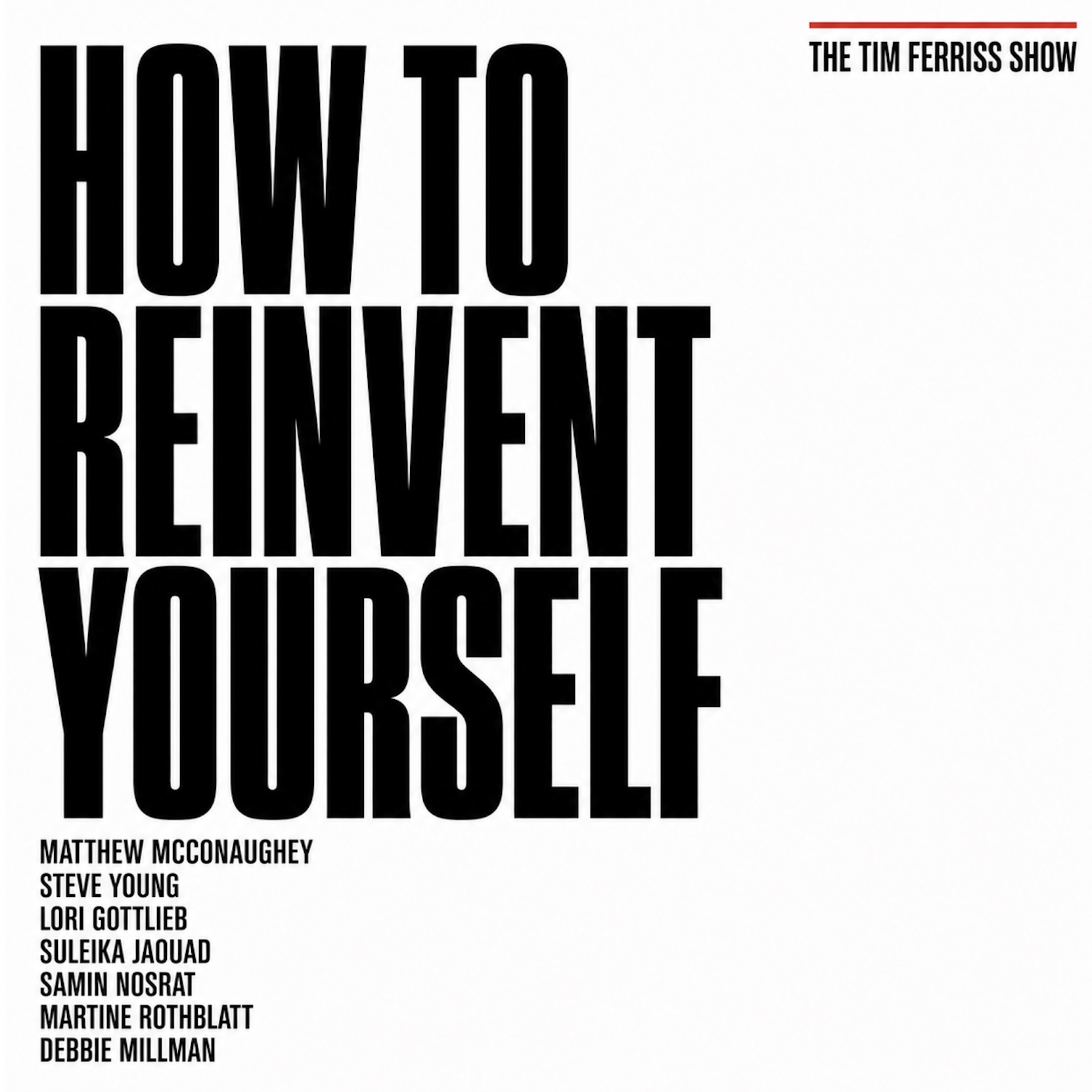
Please enjoy this transcript of a special compilation episode devoted to reinvention: how to shed an identity that no longer fits, decide on a new chapter, navigate uncertainty, and commit to what’s next.
Books, people, tools, and resources mentioned in the interview
Legal conditions/copyright information
How to Reinvent Yourself and Make Bold Moves — Decisive Stories from Matthew McConaughey, Steve Young, Samin Nosrat, and More
Additional podcast platforms
Listen to this episode on Apple Podcasts, Spotify, Overcast, Podcast Addict, Pocket Casts, Castbox, YouTube Music, Amazon Music, Audible, or on your favorite podcast platform.
Transcripts may contain a few typos. With many episodes lasting 2+ hours, it can be difficult to catch minor errors. Enjoy!
STEVE YOUNG
Steve Young: Well, let’s back up because what you’re alluding to, I think, is that what we’ve been talking about really for the whole time is transition.
Tim Ferriss: Yeah, exactly.
Steve Young: And the difficulties because I love football and I was very successful at it, I run into a lot of people who played in high school and loved it. The dream, like they would give their arm to be able to, or leg to be able to play in college and keep the dream going. And I always think about how when I left the game, it wasn’t necessarily forced, but you do age out. It just sooner later, even Tom Brady aged out at 45. It’s a young man’s game. And I remember the day before, the day I retired, I was known for this thing that I had been able to do worldwide even. The next day I remember waking up and now that that’s gone.
Tim Ferriss: Now what?
Steve Young: Yeah. Yeah. And what I’ve learned about transition that leads to Rich Lawson, how I describe it, that everyone, and even the high schooler, the last day they play and it has to be put away, needs to recognize and treat it like a death, to mourn it and go through all the steps of mourning it and burying it and actually having it as a place that you can keep referring to as almost like a grave site. Because otherwise you carry it around and it never gets — you never transition. Transitioning is about actually moving from to, right? And so I’m really grateful, Roger Staubach, the poster on my wall, I got to know him. He became a friend. Like it’s insane.
Tim Ferriss: Yeah. How cool is that?
Steve Young: And he famously transitioned, probably the most successful transition in the history of the NFL.
Tim Ferriss: What did he transition to?
Steve Young: The Staubach Company was a real estate business that he was hugely, hugely successful. And I remember asking him towards the end of my career, “Roger, give me some tips.” And he goes, “Run.” I’m like, “Run? Run where?” He goes, “Just run away.” That was his tip. Because he said, “The game will never leave you, but you need to leave it. You need to move on.” And I thought that was just simple, but really important.
And I tell people today, and I really want to write a book about transition because everybody is constantly transitioning, whether they like it or not. Most of it forced, right? But if there’s an authentic, vulnerable way to transition and bury and mourn, you can wake up the next day, realize I was great at something and now I’m not even good at anything else, but you know what? I’m going to —
Tim Ferriss: Learn and grow.
Steve Young: We’re going to learn and grow.
SULEIKA JAOUAD
Tim Ferriss: Just based on some of the reading that I’ve done, and also in your TED Talk, you had four hour naps in the middle of some days. You still had to make visits, or you did make visits at least to the ER at points. I’m curious to hear how you related to expectations of you perhaps. So outside of the physical aspect, did you feel there were certain expectations of you after, let’s just call it beating cancer, and then a dissonance between the reality of your experience and what was expected of you? If that question makes any sense.
Suleika Jaouad: Absolutely. I remember the day I was discharged from the hospital and was finally done with these four years of treatment, getting a slew of text messages, congratulating me on being done. And that seemed to imply an end point that I very much wanted but didn’t feel necessarily true or accurate because there were so many unanswered questions that I realized I suddenly needed to figure out, like the ones you just named. How do I hold down a job if I need to nap for four hours in the day? How do you begin to date when you’re coming out of an experience like this, and you still have a port in your chest? Where do you even — or do you bring up a cancer diagnosis without potentially scaring somebody away? Is it responsible for me to consider long-term commitments like marriage or children given my high likelihood of relapse?
Those were the questions I was swimming around in. But the other piece of it that I began to grapple with are the ways in which the hero’s journey arc is projected onto survivors. There’s this notion that when you emerge from a trial or a big trauma, you are better, braver, stronger for what you’ve been through, but I didn’t feel brave. I didn’t feel strong. I felt wrecked by this experience and had no idea who I was or how to find my way forward and what I had expected to be the final act of this illness experience, which was being cured, was actually the beginning of a very different kind of healing.
Tim Ferriss: Please say more. I would like to encourage you to continue. What do you mean by that?
Suleika Jaouad: So, in that first year after treatment, I was hell bent on moving on from this experience. I wanted to be a quote unquote normal young person. And I remember looking to my friends almost with an anthropological I, thinking to myself what does a normal 27 year old do, and trying to do those things almost as if I was play acting. And I’d go out dancing with friends and then pay for it with three days in bed. I would try to force myself to write about something other than illness, to come up with something new, and I just couldn’t. And what I came to understand is that moving on is a myth. You don’t get to compartmentalize your most difficult passages and stow them in the past. You don’t get to skip over the hard work of healing and grieving and recovering, and really uncovering who you are in the wake of that, and that instead, I was going to have to learn to move forward with this experience, with these imprints on my body and my mind, and to learn how to integrate them in my present.
So I started thinking about the language of ritual and the rules of rites of passage in these transitional moments. We have birthdays and funerals and weddings and bar mitzvahs, these —
Tim Ferriss: Mourning periods.
Suleika Jaouad: Yeah. And mourning periods. These ritualized ceremonies that allow us to shoulder complicated feelings that help us cross the distance between no longer and not yet. And what I realized was that there is no 12-step program. There is no rite of passage for when you survive a trauma like illness, and that I was going to have to create one for my own. And so that’s what I did.
Tim Ferriss: Yeah. As Tim takes a long inhale, because there’s so many questions I want to ask. I don’t want to interrupt your train of thought, but you mentioned no one gets to skip the hard work of grieving, recovering, and or in some senses uncovering the trauma or the difficulty through which they have passed. I would love to hear what type of work, whether it ended up being hard or otherwise, ended up in retrospect being really valuable. Were there any particular things you did, types of therapy you experimented with, anything at all that really seemed to help with those checkboxes? These are the things that must be done before you can pass go. You don’t get to skip these seven steps. Was there anything that really stood out as valuable or helpful in terms of that work?
Suleika Jaouad: So the truth is I didn’t do much of that work that first year. I had done therapy while I was sick. I had gone to support groups for young adults with cancer, but in the aftermath of that experience, because of that projection that this was supposed to be done, I didn’t have in place those same kinds of support systems and structures. I think when someone gets diagnosed or when someone loses a loved one, if you’re lucky to have friends and family, everyone rallies around you in that moment of acute distress, but in my experience and the experiences of so many other people that I’ve befriended or interviewed, it’s the quieter weeks and months after that are the hardest, because you don’t have the cavalry running after you and you’re left to your own devices. And so all those sources of support that I had created for myself or sought out in treatment, I no longer had in the wake of treatment. And so I really had to invent my own. But this notion of recovery is something that I spent a lot of time reflecting on. The word recovery implies a return to something. And I think that in that first year, I was really trying to return to the person I’d been pre-diagnosis and very quickly realized that person no longer existed. And that though the word maybe implied otherwise, recovering wasn’t about a return to the old, it was a brute, terrifying act of discovery.
And what was helpful was I met a doctor who I was actually interviewing for a story and we got to talking and I explained to him some of the things I’ve been struggling with, and he said to me, “It sounds like you have post-traumatic stress disorder, you have PTSD.” And that was a revelation to me because I thought of PTSD as something that’s reserved for veterans returning from war or someone who has experienced a kind of violence. It hadn’t occurred to me that it also applied to emerging from a long period of life-threatening illness. And once I actually understood what it was that I was feeling, once I removed any expectations of what this post cancer experience is going to be like, and I actually was able to confront the facts of what was happening face forward, then I actually began to create a plan for myself.
Tim Ferriss: What did that plan look like and was it mostly focused then at that point on the present state awareness of this possible diagnosis of PTSD? So rather than being trapped in the past, trying to revert to this pre-illness version of yourself that no longer existed, did the plan focus then on this diagnosis or possible diagnosis of PTSD? What did it look like?
Suleika Jaouad: The simplest way for me to say it is that I understood I needed time to heal, which wasn’t something that I had allowed myself. I’d been pushing myself to figure out what I was going to do next and to get back into the motions of living immediately. But more than that, what I understood was that I needed to learn how to feel safe again in my own body. I write in the book that when the ceiling caves in on you, you no longer assume structural stability. You have to learn to live along fault lines. And so that really became my work. I wanted to feel safe in my body. I wanted to learn to become my own caregiver after years of being dependent on other caregivers. And more than anything, I wanted to carve out the time and space to figure out who I was and what that path forward was going to look like for me. So what I did was I started by confronting a smaller fear, but still a pretty significant fear for me, which was learning how to drive.
And so that’s what I did. I learned how to drive. And as I began learning how to drive, I started dreaming of going on a long road trip. And as I began dreaming of that, I began to imagine a solo cross country road trip. And I didn’t just want to go on some touristy boondoggle, but I was really seeking out people who could offer guidance in this strange limbo in-between place that I found myself in. And so I ended up making a list of about 22 strangers. All of whom had written to me in response to my calm about all kinds of reckonings and interruptions in their own life. And that’s what I set out to do. I had this newly minted driver’s license, which I’d had for about a month. I rented out my apartment and used the funds from that to pay for my road trip. And I reached out to all of these different people to let them know I’d love to meet face to face and I left home.
Tim Ferriss: Into the unknown.
SAMIN NOSRAT
Tim Ferriss: … Why was the food market so quickly popular? Were there any particular reasons that come to mind?
Samin Nosrat: I think part of it was timing of it. What it was, I was really good at making pasta. I lived in Italy for two years. I made pasta every day for 10 years. I really love making pasta. When the restaurant closed, I would sort of bump into people in town and they’d be like, “Well, we really miss your pasta.” I really enjoy the beautiful manual labor of making it and the folding, and the cutting and the whole thing. I thought, “Well, what if I cut out all of the parts of having a restaurant that I hate, and I just make the pasta and sell it to people?”
I had these friends who had a commercial kitchen that was empty a lot of evenings; they let me use it, and I was like, “Okay, well, how do I sell this pasta to people?” I think it was 2009, so I think it was before Instagram or it was certainly before Instagram was really big, and I maybe had a Twitter with five followers, but really, Facebook was the main thing that I used, and so I think I put on Facebook, “I’m going to sell some pasta, does anyone buy it?” And I made a Google Doc and people started buying it.
I opened a little Shopify storefront where people would order the stuff online, so I would know exactly how much to make because a big thing in food is, it’s already so hard to make money, and really, if you’re not efficient in terms of every decision of how much labor and ingredient, you’ll really lose money. By sort of taking my orders in advance, I knew exactly how much to make, and nothing was going to go to waste and then people would come pick up their stuff.
Then, very quickly, it grew from just pasta to pasta and sausages, to pasta and sausages and cookies because everyone else that I knew who is an unemployed cook who maybe wanted to start their own food business also wanted to do these things. We started doing this, and all of a sudden, it became this online marketplace where you could preorder and prepay for your food and then come and pick up your stuff a week later. It was sort of this way to get beautiful restaurant quality stuff at home, but it was certainly before Caviar, it was certainly before a lot of these internet food things and it was also before Good Eggs, which is a food tech startup that was sort of born out of this thing.
It was definitely one of the first online, I don’t know, order your food thing. I don’t know, it was just a weird time. Then, we had a mailing list from the restaurant and I started sending it out to that, and then, very quickly, because the press was very interested in this weird way that I was operating this thing, the mailing list grew to many, many tens of thousands of people, way more than I could support.
Tim Ferriss: Wow, yeah, that’s a lot.
Samin Nosrat: It was a whole thing that grew out of control beyond the resources I had very quickly, and I was always struggling to keep up and that became such a source of stress. All I had wanted to do was to make some pasta.
Tim Ferriss: Yeah, funny how things –
Samin Nosrat: All of a sudden, I’m managing 9,000 business licenses and permits and health department and taxes and sales tax and vendors, and vendor inviting, and people wanting their beans vegan or whatever. It was so much more than I ever wanted to do, and it took so much energy and I couldn’t do it anymore. I knew I couldn’t do it anymore.
Tim Ferriss: You have this feeling, “I can’t do this anymore,” which I think a lot of people have, and yet, they keep doing it for a long time and maybe forever to a certain extent. Now, while this is happening, you have these maternal instincts kicking in which make you feel obligated on some level to help these people who, at least in your head at some point and in their heads, depend on this income. Do you remember the meal, the drinks you had with a friend, the walk you took where you’re just like, “You know what? Fuck it, I have to close this down.” When you went to thinking about winding it down to, “Okay, tomorrow morning, that’s it. I’m doing it.”
Samin Nosrat: I’m pretty sure it was therapy.
Tim Ferriss: Yeah, okay, all right.
Samin Nosrat: I’m pretty sure it was therapy and I’m pretty sure, I think the thought that really hit my body, that I realized it was that I had, by that point, spent 10 years cooking. I had been wanting to be a writer since I was 15 years old. I finally had a chance to make the time to be a writer. I even had an office that I had that I shared. I had everything in place.
Because this thing was ruining my life and making me miserable, I couldn’t do the thing that I always had wanted to do and was basically ready to do, and not that it was some easy thing to just go be a writer, because, what? I ended up writing blog posts for yogajournal.com for $25. It wasn’t so much income or anything, it was just, I knew that this thing was making me emotionally and almost physically ill. I just had to stop, and I think now I’m just so much more attuned to that moment, to the feeling of knowing this thing is bad for me.
No matter how many other people it’s good for, it’s making me sick, and it’s making me feel really bad. I think I try to be a lot more aware of that and sometimes now I get into situations or projects or jobs where that feeling comes up again, but I’m already in it and often now a lot of the work that I do is temporary. I do one project, I do one article, I do one story, I do one whatever.
Now, for me, it’s more about learning and being really attuned to what’s happening, even just, for example, in the process of making the show. I had never made a show before. This was this incredible opportunity that came to me. I was so excited and felt so lucky to go make it and go do it, and I still feel so lucky and so excited, but a lot of things happened throughout the making of the show that I was like, “Oh, this doesn’t feel very good,” or, “This doesn’t feel very fair,” or, “I don’t ever want to be in a situation like this again.”
Now that I know what’s possible, I know that negatively and also positively, I know what to ask for and I know how to articulate that. I will forever insist, to me, I’m going to insist on working with a lot more people of color in the future. I’m going to insist on making sure that I have a lot more power creatively in anything that I do, because I realized I became very frustrated when I didn’t have as much power as I needed or wanted. There are just things, it’s a constant learning thing, nothing’s perfect. We figure things out as we go, and we try to do our best, and what is failure? I don’t know.
It’s not that big of a deal, especially if there’s some sort of positive take away that you have, and maybe my therapist would be really proud of me. Maybe it’s really bad for me to even say that my therapist would be proud of me, but I do feel like all of these stories and all of these experiences really always come back to me sort of paying attention to my feelings.
Tim Ferriss: Yeah, hear, hear. That’s something that I’ve also personally been working on because I think I muted my feelings or viewed them as a liability for so long and I’ve –
Samin Nosrat: Me too.
Tim Ferriss: – realized, holy shit, you cannot spreadsheet your way out of everything, nor onto everything.
Samin Nosrat: No, me too.
Tim Ferriss: You really have to pay attention to that, the feelings.
Samin Nosrat: I think about that all the time. I came from a culture that’s very much about appearances and not very touchy feely in a lot of ways. I came from a family that wasn’t super touchy feely. What did I learn to do? I learned to shut down all of my own feelings and then I made my way into a profession who literally tells you to shut down your feelings. When you’re a cook in a restaurant, you don’t have time or room or space for feelings and not only emotional feelings, but if you actually burn or cut yourself, there’s not time or space to address that. You just sort of wrap your hand up and keep going.
LORI GOTTLIEB
Tim Ferriss: When you look back at your chapter changes, say, from entertainment to med school or med school to journalism, which decision or transition was the hardest? In other words, I’d love to hear more about some of the detail of one of the harder jumps. Were any of these decisions that you agonized over for days or weeks or months or was it just a flash of insight and decisive action? Which of these was difficult for you, if any?
Lori Gottlieb: Leaving the entertainment business wasn’t difficult for me because I was so clear that there was something deeper that I wanted to pursue, not that movies and television can’t be incredibly profound, but I think there was something that was more personally resonant for me about working with actual people out there which foreshadows, of course, what I do as a therapist. What was hard about that change was everybody thought I was crazy, that everybody said, “How do you leave this place that you’re in in your career? How do you leave that and just go to medical school?”
I think what was harder was leaving medical school because I had already made this switch. I was up at medical school. It takes a lot, by the way. You have to take all the classes to take the MCAT, you’d take the MCAT and then you have to meet all the requirements. I was, again, not a science major, although I was very math-y and science-y as a person. I was on the math team, those kinds of things, but I was very much taking humanities courses in college and literature. I think that doing everything that it took to get to medical school, getting into a medical school, being at a medical school and then saying, “You know what, I’m going to go be a freelance journalist.”
Tim Ferriss: Not just any medical school either, right? You’re on Palm Drive or nearby with beautiful Stanford, so I can imagine that also has a decent bit of waiting in some people’s minds.
Lori Gottlieb: Well, also financially, I think that we’re so worried about talking about money in our culture, but I think it’s a very real thing. I think people need to talk more about it because there I was, I already paid for two years of medical school and I had loans and all of that. Now I’m going to go be a freelance journalist. Who does that? I think what it was is what I was talking about earlier is that voice, that quiet voice where everybody else is saying, “Just finish medical school. Just get the degree and then figure out what you want to do. Just tough it out for two more years.” I was like, “Life is short.” I was very aware of that even back then.
This is a theme that you see all over my work, which is this theme of why thinking about death makes us happier, which is I don’t mean dwelling. Just acknowledging it. Just acknowledging that life has a 100 percent mortality rate and most of us don’t know how or when we’re going to die. I think that even though I was in my 30s then, which sounds young, it’s not. It’s like, why should I spend those next two years in medical school when I know that I want to go? Right? When that’s what I want to do is I want to go tell other people’s stories, I want to go do this work, that’s where the fire in my belly was.
I just followed the fire in my belly, and I said, “I’m going to have to make sacrifices, I’m going to have to make a lot of financial sacrifices and I’m going to have to write a lot to make enough money to support myself and to pay off my medical school loans, etcetera.” Now, I had some money saved up from Hollywood, but not enough to sustain me. These are the choices that that people make. It was again a choice where people said, “I really suggest you do this, that, or the other thing,” and I really listened to myself and what I wanted to do and becoming a therapist was the easy choice in the last of the changes, but I feel like every single thing that I did was really just looking at story in the human condition from a different perspective.
I don’t feel like I had four different careers. I feel like I had one career and I’m just experiencing them from different ways of getting in.
MARTINE ROTHBLATT
Tim Ferriss: You seem to be good at many things, of course, just based on the bio alone. But what strikes me is how quickly you were able to develop expertise in new fields. And I’d like to use this as an opportunity to bring up what was mentioned at the very beginning of your bio, and that is: “United Therapeutics, a biotechnology company she started to save the life of one of her daughters.” I’d love for you to provide some context for this and tell a bit of the story just because people will want to hear it. And then the follow-up just to plant the seed for it is how you learned biology. Because my understanding is you didn’t have much in terms of background in biology. So that’s a huge mouthful of a question, but if you could give us a bit of the background, that would be extremely helpful, and we can use that as a jumping-off point.
Martine Rothblatt: Sure. So it’s kind of funny that you can go all the way through undergraduate at a great place like UCLA and never be required to take a life science course, but that was the case. So the last biology class I had was in high school and here suddenly I was faced with a situation as an adult while running SiriusXM, that our youngest daughter is diagnosed with a fatal illness. She can’t even walk up a couple of stairs to the front door and there are no medicines approved for it. I finally got her to the best doctor one could find, the Head of Pediatric Cardiology at Children’s National Medical Center in the middle of Washington DC. And the doctor said, “This is an extremely rare disease. No one knows why it arises. All the patients die within two to three years.” He had only seen two or three other kids with it and they both died. “And all you can do is hope for a lung transplant.”
So Tim, I was completely crushed. I just saw black. I mean, I didn’t know what to do. And the only thing I could think of doing while she was in the intensive care ward night after night and myself, and Bina would tag team, staying there with her was once she fell asleep to go down into the library and to just begin learning about what was this illness she had, which they told me was called pulmonary arterial hypertension. And why were there no treatments available for it? So I just began reading and reading and reading.
Most of the time I read things, I didn’t understand what they were talking about because there were these long medical words and chemical words that I never learned in law school, or we never had to deal with in electrical engineering. But of course, there were dictionaries, and I looked up the words in the dictionary and they had college-level anatomy textbooks. So what I didn’t know, I just kept going backwards in academia, I guess you would say, backwards in learning or pedagogia, until I would even get to like a high school level textbook that would explain something. And I said, “Okay, I get that.” And I kept taking notes and just educated myself night after night until I learned everything I needed to know.
Tim Ferriss: How did you — and I know this is a story you’ve told before, but ultimately in searching for possible solutions. And as we were chatting about before recording, there’s a lot of luck involved. And it doesn’t mean that your path is replicable by any set of parents who are caught in a tragic situation, similar to what you experienced, but nonetheless, you were able to ultimately track down, I suppose, it’s fair to say a molecule, a drug of some type. Would you mind describing for listeners the process then of attempting to secure the ability to utilize in any fashion, this drug or to license it? If you could describe that, I have a number of questions that will stem off of it.
Martine Rothblatt: Sure, Tim. So there are a good zillion articles published on every type of medical research you could imagine. I mean, it’s just a bottomless well. There are literally hundreds of different types of medical journals. And each of those journals have every year thousands of articles published across them. So it’s difficult to find the information that you need, but in law school, we learn a very useful skill. And this skill goes by the name of Shepardizing after this type of index they have in law school called Shepard’s. So what Shepardizing involves is when a judge writes a decision like the Supreme Court issues a decision, they drop a lot of footnotes. And of course, one thing lawyers love to do is make footnotes and references. And then what you’re supposed to do as a good lawyer is to look up all of the footnotes and the references that that Supreme Court or lower court case referred to. And then the Shepardizing process is after you get all of those references to then look up all of the references in those other articles. And ultimately, you get to a point of diminishing returns where three, four, five levels down, the references are all circling back around on themselves.
So I applied that Shepardizing process to these medical articles, and somewhat like doctors, whenever a researcher publishes an article, they make footnotes and citations to other people’s research who they relied upon. So I would get all of those articles and read those. And then I would follow up on all of the references in those. Finally, I read about a molecule that a researcher at Glaxo Wellcome had written in which they described testing this molecule for congestive heart failure. And it failed in its test of congestive heart failure. It did not work, but in the article, they had charts of what the molecule did. And the one thing that the molecule did that grabbed my attention was that it reduced the pressure between the lung and the heart, which is called the pulmonary artery. It reduced the pulmonary artery pressure while leaving the pressures and all of the rest of the body perfectly fine. Well, that’s exactly the problem with pulmonary arterial hypertension, the people who have this disease — oh, I’ll make a quick footnote.
Now, when my daughter was diagnosed, 2,000 people in the US had the disease. Because medicines have become so much better, and because we’ve been able to have, like you mentioned in the introduction, get all of these approvals, there are now 50,000 people in America alone living with it. So it’s likely that people listening to your podcast will know somebody or another who has pulmonary arterial hypertension. And I read this article and I said, “Wow, just what I need. This tiny stretch of artery chest between the heart and the lungs, this molecule somehow talks to that tiny stretch of artery and leaves the whole rest of the body alone.” That was the holy grail that I was looking for. So I looked at where the author of the article was from, he was from Glaxo Wellcome in Research Triangle Park, North Carolina. And I made a beeline down to him and asked him if he could develop this molecule that he’d found for my daughter’s disease.
Tim Ferriss: Was it an immediate handing over of the keys to the kingdom, a big, all-caps YES?
Martine Rothblatt: No. It was actually a big, all-caps NO, unfortunately. The individual who had written the article had actually retired a few months earlier. And the person that I ended up meeting with, who was in charge of research and development, said that this was just one article. It was an incidental finding. In any event, this disease afflicted so few people, it was completely unrealistic to expect Glaxo Wellcome to develop this molecule for my daughter and other people with that disease. And I asked him, his name’s Bob Bell, he’s now a venture capitalist and very successful gentleman. I asked Dr. Bell, I said, “What would it take for you to develop this medicine?” He said, “Well, it probably would take — you couldn’t do it. We only develop medicines if they have more than a billion dollars a year in revenue potential.” He said, “But it’s possible you could buy it from us. If you had a real pharmaceutical company with real pharmaceutical expertise, I could then introduce you to the business development people at Glaxo Wellcome.”
So over the course of the next several months, I created a brand new biotechnology company. I was able to have a Nobel Laureate who was formerly associated with Glaxo Wellcome become head of a scientific advisory board. And I reapproached Glaxo Wellcome. And I said, “I have all the things that you asked for. Can you sell me this drug and we’ll develop it ourselves?” Well, Tim, it turns out that everybody I asked said, “Well, you have to get somebody else in the company to agree.” And that’s how it is in a big bureaucracy. It turned out that we had to have 15 different executives sign the same piece of paper to agree to license this drug to me.
Finally, it happened. And all they wanted really was $25,000 and a promise of 10 percent of any money that I would ever get from this molecule. I think they agreed to that only because I kept bugging them. I was in their face all the time. And also because I believe a serendipitous factor was that Dr. Bell’s sister had contracted a form of pulmonary hypertension from the time I first met him toward the end of this process. And he became a product champion for me within Glaxo Wellcome. I mean, that was just purest luck or serendipity, whatever you want to say. And then they really didn’t think this molecule had any chance at all. And they were really just doing it to get rid of me, I think, but still, all 15 people had to sign it.
And after we successfully developed this molecule, Tim, we have over time paid more than a billion dollars just in royalties to Glaxo Wellcome because that molecule has saved thousands of people’s lives. It has produced a billion dollars a year in revenue year after year after year for us and Bob Bell, when I invited them to our 15th anniversary and he came with his sister who was still alive and on our medicine, and he said this was the absolute best transaction that Glaxo Wellcome had ever done.
MATTHEW MCCONAUGHEY
Tim Ferriss: Well, let’s talk about, perhaps an uphill, perhaps a pause, perhaps something else, which I’d love for you to comment on what you did come later. And that was a decision which I’d love to explore, to say no to quite a lot of opportunities for a period of time. It seems like at one point, you were very successful, you became very famous, like you said, practically overnight. You’re being offered opportunities you couldn’t have imagined a week prior, and you have a string of successes and then you realize, “Well, wait a minute, here, I might be getting painted into a corner,” and you start to say no.
You start to turn down, say, action film opportunities with big paychecks, things like that. Was that hard to do? Did other people say that you were doing the right thing and encourage you? Could you walk us through and just tell a story about that experience?
Matthew McConaughey: Yeah, love to. So this is around—I don’t remember the year, I’m guessing it’s around 12, 13 years ago. I was rolling with romantic comedies. I had taken the baton from Hugh Grant and was the male lead rom-com go-to guy.
Rom-coms are mid-level budgets, 30, 35 million. They offer a good front-end paycheck to me. They go make 60 million. I mean, the studios don’t have to overspend and spend hundreds of millions of dollars to make them.
You get a good female and a male lead that have good chemistry. People love to go escape to them. My rom-coms are doing well. They were my bank. They were what Hollywood banked on me to be in. At the same time, I’m living in Malibu, learning to surf, got my shirt off, and the paparazzi are Discovery Channels like almost documenting this, and I’m like, “You damn right document it. This is the life I’m living. I love it. I worked and earned to get this life. And those romantic comedies that I get paid so handsomely for, actually pay the rent at the house on the beach that I live in, in front of this water that I’m surfing in.”
So I was full on shaking hands with—I was going, “Yes.” At the same time, I did notice that any other dramas I wanted to do, or even the way people sort of—when I said, “Don’t meet strangers anymore.” Even when the way these sort of people thought of me or approached me or would talk to me or about me, there was no consideration.
It was like, “McConaughey is the shirtless rom-com guy.” And I was like, “Yeah, I am, and I’m—” But only I could answer that second question of, “And I’m—” like only I could continue that sentence. No one else could. And really Hollywood, for sure was like, “No, nothing else,” and so any dramas I wanted to do or other pictures, no one wanted to make them with me.
And I remember we had just had Levi. Camila and I just had our first son, and my life was so vital. Man, I had just had a newborn, I’ve met the woman that I love and want to spend the rest of my life with. I’m laughing harder. I’m crying harder. I’m happier than ever. Life is very vital and I’m in it. My real life is, but my work feels like, “Yeah, I can do that tomorrow morning. Just give me the script tonight, let me look at it. I can do it tomorrow morning.”
It wasn’t really challenging me, and the rom-coms weren’t challenging me, and my lifestyle was one big green light. And to me, if it’s all green lights, if it’s all sugar and candy, well, that’ll make tyrants out of anybody.
So I was saying, “Oh, I wish my work could—” I remember saying this. I remember looking in the mirror actually, and going, “Okay, McConaughey, so if your life is more vital and true to who you are than your work, well, if it’s got to be one or the other, that’s a good thing, because I know a lot of people that their work is more vital than their life.”
So I said, “That’s a good thing.” I said, “But jeez, could I just get some work that might challenge the vitality of my life and the man I am in it? Where I can get some work, where I can be more me in it?” Well, those roles were not being offered to me. Nothing, nope, not a chance.
No studio will bank you in this drama role, or this other role you want. I had control of Dallas Buyers Club at that time, but no one wanted to make it for me, nor would anyone finance it. So I decided that if I couldn’t do what I wanted to do, and what I wanted to do was not being offered to me, it would be prudent for me to just stop doing what I had been doing and what was in the pipeline continually coming to me, which were the romantic comedies.
I called my money manager, I said, “All right, look, I’m going to stop doing the only work I’m getting offered. And I don’t know how long it’s going to be till I work again. How am I doing with my money?” He says, “You’ve invested well, conservatively. You’re fine. You can take time off.”
I remember calling my agent, Jim Toth. I would say, “Hey, Jim, I don’t want to do romantic comedies anymore.” I remember this conversation, he goes, “Great.” And I go, “Wait, woah, woah, woah. What do you mean, great?” He goes, “Great.” And I go, “How do you say that so quick? What are you going to say Monday morning when you go into your superiors in the office and say, ‘McConaughey’s not doing romantic comedies,’ and McConaughey has been bringing a nice chunk of 10 percent commission into you guys with these romantic comedies for years now. And he said the coolest thing to me, he goes, “I don’t work for them; I work for you.”
Tim Ferriss: That’s a good line.
Matthew McConaughey: And he meant the line, right? And then it was I went to Camila, my wife. And I’d shed quite a few tears with her going through this. Am I feeling fraudulent in my work? Do I feel a lack of significance in my work? Do I feel like—is it okay to be feeling this? I mean, remember as we said earlier, I’m tired of going running downhill. Why would you sabotage not doing the work you’re getting offered when you can get paid so handsomely to do it? But she understood that my soul was shaken and needed some recalibration and that the work I was doing wasn’t the true expression of who I was in my life. I told her, I said, “I want to hold out for some work that can challenge the vitality of the life that I’m living with you and our son Levi.”
And she repeated the lines to me. She goes, “Okay. You’re going to get wobbly. I’ve been around you, you’ve got to work, Matthew, and you love to accomplish. You’re going to get wobbly. You might start reaching for a little sip of something to drink earlier in the day too.” And I’m like, “Yeah, yeah, yeah.” She’s like, “Me, too.” She goes, “Days are going to be longer. We don’t know how long this will last, how long we’ll be in this”—she called it a desert—”how long this will be a desert?”
She goes, “But if we’re going to do this, if you’re going to do this, we’re not going to half-ass it.” She repeated my dad’s line to me. And I went, “Yes, ma’am.” Gave her a hug, put some tears on her shoulder, and we said, “Starting today, no more rom-coms.” Well, rom-com offers came in to my agent for about the next six months, but nothing but rom-com offers.
Unless it was a major offer, I just said no. And they just stopped at my agent’s desk, Jim Toth. No. And then one of them came through that was a gargantuan offer for it. And my agent said, “It’s a pretty damn good script, too.” And so I said, “Well, send it out, let me read it.” I remember reading it, and I remember the offer was for $8 million, and the script was pretty good, but it was still kind of a rom-com.
And I remember reading it and going, “No, thank you.” I remember feeling sort of emboldened and strengthened by saying, “No, thank you. Great. Sticking to my guns. No rom-coms. Six months into this drought. No, I’m not caving in now. Don’t half-ass it, McConaughey.” So they come back with a $10 million offer. “No, thank you.” They come back with a $12.5 million offer. Now I go, dot, dot, dot ellipsis, ellipsis, “No, thank you.” Now they come back with a $15 million offer.
Tim Ferriss: Wow.
Matthew McConaughey: And I said, “You know what? Let me have another reread of that script.” And I reread that script. And you know what? At $15 million, the same script that I’d been offered for $8 million, the $15 million offer script, which was the same exact words as the $8 million offer script, the $15 million offer script was better, it was funnier. It had possibilities, it had angles, I had ideas, I could make this work. I mean, this could work.
Tim Ferriss: Now I’m imagining at this point, Jim is like, “Man, this saying no thing is really working out!”
Matthew McConaughey: He’s in and he’s over there teetering like, “I know what we said, but $15 million and it’s not like—it’s a pretty good script. I know it’s rom-com. It’s a pretty good script.” But I said, “No, thank you.” Well that got the signal across Hollywood that McConaughey was taking a serious sabbatical. And so don’t even send him a rom-com. It got around.
Tim Ferriss: So that was the crucible, then. I mean, that was the crux move, in a sense.
Matthew McConaughey: In a way, that was—I called an audible six months in and I had them thinking I might cave, I might just be posturing and, “Come on back, McConaughey. Hey, we love you.” And I said, “No.” And when they had pumped the money offer up so much, and people knew in the industry what that offer was, it became very clear, “Oh, shit, okay. McConaughey, I don’t know what he’s doing, but he ain’t doing this stuff. He’s not doing any more rom-coms.”
And it became clear. So for the next 12, 14 months, nothing came in, nada, zilch, not an offer for anything. I mean, I’d talk to my agent every couple of weeks. It’d just be like, “Nothing came in, nothing.” So now we’re 20 months into this desert period. I do have my son to raise, which being a father has always been the most important thing to me.
So that’s got my compass at least directed in a place that I go, “Just trust in this, if it has something to do with raising your son and being here on the land with your family, even if you start to wander, just trust that that’s always going to be in the asset section, McConaughey, you can’t go wrong with that.”
So I stuck to that. And I was now fine with not doing any work. I didn’t know what I was going to be, I didn’t know if I was going to change my career, if I was going to become a teacher, or a coach or go back to being a lawyer, I didn’t know, I didn’t think so, but I was writing more.
Talking about forced winters, I had put a forced winter on myself and I was pretty content. I wasn’t waking up every morning, going, “Did an offer come in? Did something new come in?” I was past that. And then all of a sudden, 21 months into this desert, I start getting some offers that are interesting things, William Friedkin, Killer Joe. Lee Daniels, The Paperboy.
Jeff Nichols wrote Mud for me, Steven Soderbergh called, Magic Mike. Richard Linklater and I go do Bernie together. True Detective comes around, all of a sudden, Dallas Buyers Club. No one still wants to put a bunch of money up for a 1980s period drama about AIDS, but all of a sudden, McConaughey, all the directors or no directors would do Dallas Buyers Club with me, they wanted the script, they loved the script, they didn’t want to do it with McConaughey.
All of a sudden we find Jean-Marc Vallée who says, “No, I’d like to do it with McConaughey.” So what happened was that 22 months or whatever, that drought, that desert, I unbranded. I didn’t rebrand, I unbranded. Me being away, me being in Texas, not being on a beach getting pictures of being shirtless on a beach, not being in rom-coms, I was out of the world’s view.
I was out of the industry’s view, I was not in your living room, I was not in your theater, I was not in any of the places that the world had become expectant to see me and how to see me. Where was I? I was gone. Where is McConaughey? When you’re gone long enough, all of a sudden, I became a new, good idea. Which I was not a new, good idea earlier at the end of that 20-month period, and then all of a sudden things came to me that I wanted to do and I remember saying, “You know what? Fuck the bucks, I’m going for the experience. If I read a role that shakes me in my boots, and challenges the vitality that I feel in my own real life, and challenges me, the man I am in my own real life, that’s what I’m going after.”
And man they came in. Camila and I looked at each other, shed some more tears, and we said, “Let’s get after it.” And I just started hammering them. The family came with me everywhere I went, and just started laying down work that really, really turned me on.
DEBBIE MILLMAN
Debbie Millman: So, the exercise that I do now with my students, because they are quite a bit younger than I was when I was doing this five-year plan, I ask them to do a ten-year plan.
And so, this gives them a chance to really mature into who they are in their 20s and into their early ‘30s. And it’s this ten-year plan for what I call a remarkable life. It’s about imagining what your life could be if you could do anything you wanted without any fear of failure. And they are the most life affirming essays. They are so, full of hope and optimism and well being and goodness, that it gives me a sense that humanity can be saved. So, I borrowed that exercise from Milton and now use that both in my graduate program and the undergraduate classes that I teach.
Tim Ferriss: This is going to seem nerdy, but I’m a nerd and I’ll run with it. Do you have any parameters for people at home who might want to try this, or recommendations, ways to start? Is it bullets or is it in prose in full paragraphs? How does it end? Any recommendations for people who would like to give this a stab?
Debbie Millman: So, let’s say it is winter, 2027. What does your life look like? What are you doing? Where are you living? Who are you living with? Do you have pets? What kind of house are you in? Is it an apartment? Are you in the city? Are you in the country? What does your furniture look like? What is your bed like? What are your sheets like? What kind of clothes do you wear? What kind of hair do you have? Tell me about your pets. Tell me about your significant other.
Do you have children? Do you have a car? Do you have a boat? Talk about your career. What do you want? What are you reading? What are you making?
What excites you? What is your health like? And write this day, this one day ten years from now. So, one day in the winter of 2027; what does your whole day look like? Start from the minute you wake up, brush your teeth, have your coffee or tea, all the way through until when you tuck yourself in at night. What is that day like for you? Dream big. Dream without any fear. Write it all down. You don’t have to share it with anyone other than yourself. Put your whole heart into it and write like there’s no tomorrow. Write like your life depends on it because it does. And then, read it once a year and see what happens. It’s magic. It’s magic, Tim.
DUE TO SOME HEADACHES IN THE PAST, PLEASE NOTE LEGAL CONDITIONS:
Tim Ferriss owns the copyright in and to all content in and transcripts of The Tim Ferriss Show podcast, with all rights reserved, as well as his right of publicity.
WHAT YOU’RE WELCOME TO DO: You are welcome to share the below transcript (up to 500 words but not more) in media articles (e.g., The New York Times, LA Times, The Guardian), on your personal website, in a non-commercial article or blog post (e.g., Medium), and/or on a personal social media account for non-commercial purposes, provided that you include attribution to “The Tim Ferriss Show” and link back to the tim.blog/podcast URL. For the sake of clarity, media outlets with advertising models are permitted to use excerpts from the transcript per the above.
WHAT IS NOT ALLOWED: No one is authorized to copy any portion of the podcast content or use Tim Ferriss’ name, image or likeness for any commercial purpose or use, including without limitation inclusion in any books, e-books, book summaries or synopses, or on a commercial website or social media site (e.g., Facebook, Twitter, Instagram, etc.) that offers or promotes your or another’s products or services. For the sake of clarity, media outlets are permitted to use photos of Tim Ferriss from the media room on tim.blog or (obviously) license photos of Tim Ferriss from Getty Images, etc.
