

Let’s take a moment to revel in the wisdom of the great Jamie Dimon, speaking here at the Council on Foreign Relations CEO Speaker Series a few weeks back:
JPMorgan Chase CEO Jamie Dimon on the lack of arms manufacturing capacity in the US:
We did not have productive capability to double or triple our Patriot missile production. No one’s willing to pay for it.
No cars were built in America in 1942, ’43, ’44, ’45.
We did build… pic.twitter.com/HwRjD00Z6A
— Clash Report (@clashreport) June 27, 2026
Yeah, man. After you and your pals spent decades cashing in on deindustrializing the country ruining millions of lives in the process, you now find out it’s tough to continue spreading freedom for American capital without the bombs. Just flip that switch. The problem is it’s not so easy.
It’s not that no one will pay for it. What’s Dimon smoking? The US drops a trillion-plus per year on its war machine. The problem is you outsourced the knowledge and capacity. And even while Dimon waxes poetically about the great Arsenal of Democracy (that’s currently supplying a genocide), they’re still selling out the country.
One silver lining is that these oligarchs’ own greed might be what ultimately forces them to retreat from ransacking the world. But let’s first take a brief stroll down memory lane before catching up on the latest in the great American sell off.
Thirty-Plus Years at the American Auction House
In the late 2000s and early 2010s JP Morgan ran a “Sons and Daughters” program that bribed Chinese officials by hiring their unqualified offspring of high-ranking Chinese officials. This helped grease the wheels of the dealmaking that would see China take over American industry.
Who was JP Morgan CEO at the time? You would not be wrong if you guessed Sir Jamie who took the reins in 2006. The “Sons and Daughters” program was expanded and institutionalized in 2009.
Why was JP Morgan doing this? Well, before China became enemy number one—or two or three depending on the day—it was a lucrative target for unloading American crown jewels.
JP Morgan and friends were the ones doing the selling. It’s good that Jamie is noticing the problem. That’s why he gets paid the big bucks. Lowly workers only beat him to it by…26 years. And Matt Stoller and Lukas Kunce warned about the breakdown in the defense industry seven years ago. From The American Conservative:
When Wall Street targeted the commercial industrial base in the 1990s, the same financial trends shifted the defense industry. Well before any of the more recent conflicts, financial pressure led to a change in focus for many in the defense industry—from technological engineering to balance sheet engineering. The result is that some of the biggest names in the industry have never created any defense product. Instead of innovating new technology to support our national security, they innovate new ways of creating monopolies to take advantage of it.
One way they took advantage of it—and allowed the US to be taken advantage of—was by shifting the supply chain to low cost China:
Two of Xiaoping’s sons-in-law approached investment banker Archibald Cox, Jr. in the mid-1990s to use his hedge fund as a front for their companies to buy the U.S. rare-earth magnet enterprise. They were successful, purchasing and then moving the factory, the Indiana jobs, the patents, and the expertise to China. This was not the only big move, as Cox later moved into a $12 million luxury New York residence. The result is remarkably similar to Huawei: the United States has entirely divested of a technology and market it created and dominated just 30 years ago. China has a near-complete monopoly on rare earth elements, and the U.S. military, according to U.S. government studies, is now 100 percent reliant upon China for the resources to produce its advanced weapon systems.
Wall Street’s outsized control over defense contracting and industry means that every place a foreign adversary can insert itself into American financial institutions, it can insert itself into our defense industry.
At an Armed Services Committee hearing in 2018, Representative Carol Shea-Porter talked about how constant the conflict between financial concentration and patriotism had been in her six years on the committee. She recounted a CEO once telling her, in response to her concern about the outsourcing of defense industry parts, that he “[has] to answer to stockholders.”
Who are these stockholders that CEOs are so compelled to answer to? Oftentimes, China. Jennifer M. Harris, an expert in global markets with experience at the U.S. State Department and the U.S. National Intelligence Council, researched a recent explosion of Chinese strategic investment in American technology companies. She found that China has systematically targeted U.S. greenfield investments, “technology goods (especially semiconductors), R&D networks, and advanced manufacturing.”
The trend accelerated, until the recent flare-up of tensions between the United States and China. “China’s foreign direct investment (FDI) stock in the U.S. increased some 800% between 2009 and 2015,” she wrote. Then, from 2015 to 2017, “Chinese FDI in the U.S. …climbed nearly four-fold, reaching roughly $45.6 billion in 2016, up from just $12.8 billion in 2014.”
Borders didn’t matter (still don’t for the most part). Transnational capital was all the rage (still is). Monopolies and sugar highs was where the smart money was (unchanged). And above all, thanks in part to rampant offshoring, the rich were winning that class war once and for all (same).
But now all of a sudden Dimon and friends find the citadel of American capitalism is constructed on quicksand. What have they learned? Precious nothing.
Neoliberal Industrialization
The World Bank, as a stand in for Western elite financial opinion, might appear to have changed its mind on industrial policy after decades of dismissing it, but what it is now pushing is oxymoronic industrial neoliberalism through militarization and police state surveillance.
This means a continuation of the war on labor and further directing of public spending away from the commons to so-called strategic sectors like weapons manufacturers, energy companies, and AI. Due to the nature of parasitic capitalism sucking up so much cash, it will take boatloads of public dollars to have any hope of flipping Dimon’s switch.
All the better for him and his friends as this late-stage capitalism militarization and police state push means a reduced quality of life for most, but will be very profitable for some. In short, we will suffer so their order might remain stable.
Nationalism It Will Not Be
Old industrial capitalism might’ve required stability; the transnational Dimons of today can prosper from instability and collapse.
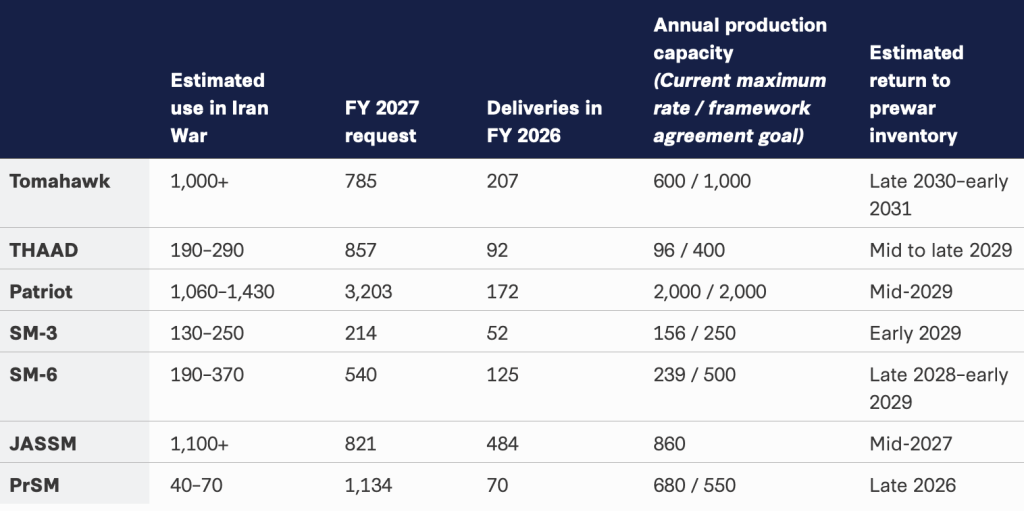
As Dimon calls for a return of the Arsenal of Democracy, the US has taken multiple actions against China—too late, one might add— in a bid to kickstart some strategic production. It’s going to be an uphill climb, as the a missiles stocks inventory demonstrates:
Source: Center for Strategic & International Studies
Turns out flipping the switch is hard. And those timelines could get a lot longer if Beijing gets tougher on exports of rare earth and other strategic necessities.
The more optimistic US strategists don’t look at US industrial capacity alone, however; they include the vassals. From the Council on Foreign Relations:
China has four times the population of the United States, and its economy, while slowing, is roughly 25 to 30 percent larger than the U.S. economy when measured by purchasing power parity. Its manufacturing capacity is twice that of the United States, exceeding the next nine countries combined. China produces twenty times as much cement as the United States, thirteen times as much steel, three times as many cars, and twice as much power. It accounts for two-thirds of the world’s electric vehicles, three-quarters of batteries, 80 percent of consumer drones, and 90 percent of solar panels and refined critical minerals. It is pulling ahead in the next industrial revolution: it installs half the world’s industrial robots and produces more active patents and top-cited scientific publications annually than the United States.
The military balance is changing, too, largely because of that industrial strength. China fields the world’s largest navy, holds the largest stockpile of conventional cruise and ballistic missiles anywhere, outproduces the world in drones, and likely possesses the world’s most advanced hypersonic systems.
…But even though China has greater scale, the United States has a decisive advantage. Combined with its partners—Australia, Britain, Canada, India, Japan, Mexico, New Zealand, South Korea, Taiwan, and the European Union—the picture changes. That coalition has more than twice China’s GDP at purchasing power, accounts for roughly half of global manufacturing to China’s one-third, spends more than twice what China spends on defense, and produces substantially more patents and top-cited research.
The traditional American alliance model, designed in the Cold War, has treated partners as dependents—recipients of protection, providers of bases, and occasional contributors of industrial capability. What is required now is to transform the alliance system from a collection of managed bilateral relationships into a platform for pooled capacity-building across domains. Allies are not trip wires, vassals, or status symbols; they are cocreators of the capacity the United States cannot generate on its own.
Yet these same “allies” are also struggling to cope with China’s dominance in the strategic mineral supply chain.
Meanwhile, aside from with those currently on the US enemy list, the selling-America-out business as usual continues. One could argue the liquidation of America is actually accelerating. From Nikkei Asia:
For most of the past five decades, the assumed direction of cross-border capital between Asia and the U.S. was settled — American firms acquired Asian assets, American capital funded Asian growth and American consumers absorbed Asian production. The flow was so consistent that it was rarely interrogated.
Over the last year or so, the direction has reversed. The scale of the turnaround is now so sufficient that it deserves to be treated as a structural shift, not a cyclical anomaly…
Several transactions highlight the trend. In January this year, Mitsubishi Corp. announced a $7.5 billion acquisition of Aethon Energy’s U.S. natural gas assets, the largest such Japanese move ever announced in the U.S. energy sector. Toyota Industries was privatized in a $37 billion deal in March, the largest take-private in Japanese corporate history.
SoftBank Group committed $30 billion to OpenAI’s Stargate venture in January 2025 and completed its $6.5 billion acquisition of Ampere Computing later that year. In April this year, India’s Sun Pharma announced an $11.75 billion acquisition of New Jersey-based Organon, the largest Indian biopharmaceutical deal on record…
The Americas accounted for 60% of global M&A value in 2025, while U.S. deal values rose 55% year on year, according to consultancy PwC. Asian acquirers were among the most active buyers driving those figures.
What could go wrong?
Dimon and friends do not care about the damage it does to Americans.
They are now waking up to the fact, however, that their ability to shape the world through fire has been degraded. That is what the tears are about, and there’s never so much as frown about all the abandoned factories and towns. While it’s easy to cheer the oligarchs’ predicament, the downside to the great American sell out is that millions of Americans who just wanted a decent paying job are victims. There was once a day where all that industry and productivity could have been put to great social use building a country that elevated the quality of life for all.
It was not meant to be thanks to Dimon and friends who wanted to eat their cake and have it too. On the world stage, however, the Dimon class’ ability to use state violence to pave the way for the American capital is waning. That is no doubt a good thing. WIth any luck the greed and short-term thinking of the American capitalist class that resulted in the liquidation of the Arsenal of Democracy will eventually put an end to the unbridled arrogance of Dimon and his ilk.
And when that day comes, just remember they did it to themselves.
