

[Today’s Iran war update yet again launched before complete. Please return at 8:00 AM EDT for a final version]
We’ll soon discuss the fact that the Memorandum of Understanding is clearly never going to get done and consider what might come when it officially breaks down.
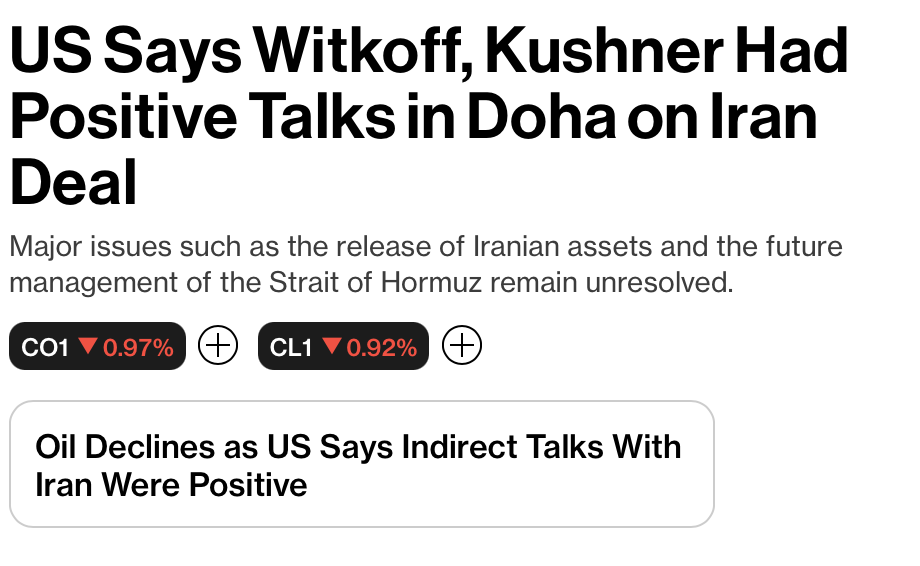
Janta Ka makes his lead item the fact that Trump set up Witkoff and Kushner for humiliation by trying to bounce Iran into a meeting in Doha with them to which Iran had never agreed and rejected:
But in the modern information war analogue to the question, “If a tree falls in the forest and no one hears it, has it made a sound?” what if “If you are dissed but the media that matters to you pretends otherwise, have you been humiliated?”
Mind you, Trump has such an extreme need to dominate that once he finds out about this slight, he is likely to get all bent out of shape on Truth Social. Right now, he is preoccupied with nursing his rage over his Supreme Court loss on birthright citizenship. This is the latest tweet I could find from him on the Middle East:
But more important, the meetings the Iranians had set in Doha were to get $6 billion in frozen funds held in Qatar released, as had been agreed under the Biden Administration and the US of course reneged. Doha News’ Facebook page has a short video of the Qatar foreign ministry spokesperson basically throwing up his hands. He says Qatar is just the middleman, and the transfer of funds has not yet occurred. Moreover, the Qatar spokesman say Iran was to use these monies in accordance with that deal, only for humanitarian purposes, meaning there were strings attached.1 So the Trump team might be trying to hang its hat on the old Biden deal to say it can restrict Iran’s use of these monies.
From the Doha News article, Qatar confirms no high-level U.S.-Iran talks in Doha, clarifies status of $6bn frozen funds:
During a weekly briefing on Tuesday, Qatar’s Foreign Ministry spokesperson Majed Al Ansari stated that while Doha continues to facilitate diplomatic engagement, no direct negotiations between Washington and Tehran are taking place.
“There is no high-level meeting currently scheduled between the US and Iran,” Al Ansari confirmed….
On the issue of Iranian assets, Al Ansari addressed reports concerning the potential release of $6 billion in frozen funds.
He confirmed that Qatar continues to act solely as a financial intermediary under a 2023 agreement between the United States and Iran, which established a humanitarian channel for the use of the funds.
“Qatar does not own these funds. It is only acting as the financial intermediary to manage these accounts within the framework of this agreement between the parties,” Al Ansari reaffirmed.
He added that any transfer of funds depends on mutual agreement between Washington and Tehran and progress in negotiations, which has not yet occurred.
So despite Iran scoring a PR win by blowing off the truly dreadful Kushner-Witkoff tag team, it still does not have any of its frozen funds. Recall that Iran had earlier attempted to have the US return some as a condition of entering into the Memorandum of Understanding.
So aside from the US ending the blockade and giving Iran oil sanctions relief so it can sell its oil without hassles, Iran seems to be nowhere on getting the US to honor the MOU.
It looks as if Iran assumed because $6 billion was formally in Qatar’s possession and had been agreed to be returned in a Biden era deal, that it would be best place to set the precedent of the US returning frozen funds because it could be spun in a way by the Trump team to be less controversial. But instead, the US is pointing to terms in that Biden deal that restrict the use of the assets to “humanitarian” purposes, which translates into the US restricting/supervising their use.
Not only is Qatar backing that position, but it seems further to be falling in line with the US position that there has to be negotiation progress on other issues before it can free up the funds. See from the Qatar remarks in footnote 1:
…the matter of transferring the funds or not is done according to mutual agreement between both parties and according to progress of the negotiations, which has not happened so far.
And the US seems to be further holding up discussion of any other frozen asset releases until this $6 billion is settled.
And recall that the US gave Iran a 30 day waiver for its oil at sea during the war. That was because the US wanted to keep oil supplies as high as possible, given the givens, to contain prices. So this area of compliance is in the US’ interest.
Reports on whether the US is even withdrawing its extra forces are contested. Larry Johnson points out in a fresh talk with Nima that Pete Hegseth signed an order to pull out forces and that all the military flight activity reported on Twitter is presumably pursuant to that, as opposed to bringing more assets and men in. Daniel Davis has also said he has heard about redeployment order having been issued.
Yet DropSite News is one of the most highly connected news outlets in the region. This is admittedly a remark in passing but Ryan Grim is part of the reporting team even though he was not on in this segment. Breaking Points reports a force buildup yesterday’s show (see at 11:20, showing a tweet from MintPress):
Similarly:
US Air Force E-3G AWACS (+ tankers & fighter jets) active over the Gulf of Oman, as most of maritime traffic is on Iran-designated shipping lanes.
An Oil Tanker “Congo Prosperity” seem to be hesitant to cross the strait of Hormuz via the US-backed corridor.. https://t.co/Z6qFF0JgEG pic.twitter.com/alguIyE9I4
— MenchOsint (@MenchOsint) June 30, 2026
We’ll turn in a minute to the various accounts of Iran and Oman discussing possible Strait of Hormuz arrangements. The short version is Oman is sticking to UNCLOS, which it has signed. Crudely speaking, UNCLOS requires that states who have territorial waters that must be crossed to allow passage to commercial vessels to open seas (aks transit passage). UNCLOS severely limits the fees that may be charged to vessels transiting natural waterways, as opposed to canals or waterways where investments in dredging were made to facilitate traffic.2
One wonders where Iran thinks these talks and the much bigger fight for regional dominance are going.
On paper, Iran has all the leverage, given its ability to kill the global economy by choking Strait of Hormuz traffic. Trump’s sudden surrender to the MOU demands and his remarks that he didn’t want to be the next Herbert Hoover seemed to be an admission that the US recognized the weakness of its position.
Yet Iran should have recognized that the MOU contained promises (or conceded to Iran demands) that the US could not honor.
The US can’t deliver the $300 billion. The MOU does not have the US on the hook for it and the US cannot make non-signatories cough up the money. The US compel other countries, notably the Europeans and any others who are honoring the JCPOA snapback, to give sanctions relief.
It is not impossible but certainly far from easy to compel the Israelis to leave southern Lebanon. The US can remove its forces deployed during the war but has not done so yet.
Even before getting to the fact that the US could never deliver on the MOU in full, US intransigence, as shown with its fight over the Iranian frozen assets and its effort to cement an Israel presence in southern Lebanon by midwifing a potential Israel-Lebanon pact says the US is acting like it still has cards to play, even when independent military and geopolitical experts almost to a person say otherwise.
Does the US believe that it can get enough oil out of the Strait of Hormuz in a tit-for-tat exchanges scenario to escape the oil cliff, based on a belief that Iran does not want to go back to a hot war and will not if the US keeps its provocations below a certain level? Or have members of the Trump team convinced themselves that even if the world economy goes tits up, the US will not be much harmed? Bloomberg oil reporter Javier Blas has regularly been flogging information tidbits supporting the idea that all is well on the supply side, so perhaps the Trump Administration is on the receiving end of similar cheery takes:
In the first 4 months of 2026, US total oil production (crude, condensates and NGLs) has averaged 21.33m b/d — that’s >900,000 b/d higher than in same period of 2025. And that’s before the US shale industry had the opportunity to react to (and hedge) ~$100 a barrel.
— Javier Blas (@JavierBlas) July 1, 2026
Or have the US and Israel convinced themselves that they have a game-changing clever trick up their sleeves?3
Traffic in Hormuz is less than wonderful but there are still transits on the Oman side:
Hormuz traffic holds steady
The Strait of Hormuz remained open and active on 30 June, with 34 verified crossings recorded and traffic evenly split by direction. The dataset showed a broad mix of commercial, energy-linked and support movements, while route visibility remained… pic.twitter.com/cVZHRte4Hy
— Kpler (@Kpler) July 1, 2026
And Lloyd’s List is making optimistic noises. Notice the use of the word “surges” in Shipping sustains pragmatic approach to Hormuz transits amid political uncertainty
- Traffic through Hormuz is growing again following recent US-Iran strikes, with shipowners relying on political guarantees, shifting security corridors and improvised convoys to move vessels through a still‑fragile chokepoint
- Iran and Oman pushing competing control plans for the strait, while US-Iran talks in Doha remain uncertain and fees proposed by Middle East Gulf states threaten to stall any long‑term agreement
- Shipping is adapting through temporary workarounds, including VLCC shuttle operations and dark transits
Hormuz traffic surges as US-Iran talks are set to resume, but a long‑term plan is still elusive and shipping is enacting temporary workarounds not a strategic return
Nevertheless, a sanity check:
The new definition of “everything is back to normal” is ~25% of pre-war traffic in the Strait of Hormuz https://t.co/tsf494eKa6
— JustDario (@DarioCpx) July 1, 2026
A fresh report (after the initial launch of this post) suggests Iran has resumed discipling ships that try to transit on the Oman side:
It’ll be interesting to learn how a vessel with an AIS-reported draft depth of 10 meters ran aground in 35-50 meters of water. https://t.co/eAlKhO0I82
— TankerTrackers.com, Inc. (@TankerTrackers) July 1, 2026
A late update: Iran reportedly took credit for the grounding:
BREAKING: Iran’s IRGC has grounded a foreign container ship in the Strait of Hormuz US-backed Omani corridor after not using Iran’s approved route, per Iranian state TV.
Iran says it has “repeatedly warned captains, shipowners and officials of shipping companies around the world…
— The Hormuz Letter (@HormuzLetter) July 1, 2026
Lloyd’s List in theory should have a better view of what is happening than other outlets. NO1 highlights the divergence in reports on amount shipped: From his latest daily report:
Export figures diverge and both should be surfaced: Iran claims 40-50M barrels since the blockade lifted (~two weeks), which HormuzReport frames as 3.4M bpd, double the pre-war 1.7M; TankerTrackers pegs the June monthly average at 1.66M bpd.
I am not about to belabor the talks between Iran and Oman right now. Oman so far is clear it will stick to UNCLOS which allows for fees but not at the “enough to serve as part of reparations” level. Iran keeps using the word “control” with respect to the Strait of Hormuz, which is also not compatible with UNCLOS. So it seems likely that Oman and Iran will find it hard to bridge the gap, particularly if Iran sticks to the position expressed in remarks by Dr. Moshen Rezaei, a senior military adviser to the Supreme Leader, in a video clip in the Breaking Points segment above. From Rezaei’s translated remarks in a lightly cleaned up machine transcript:
But regarding fees, there is a cost dimension to this matter. There is a tolls discussion, a fees discussion. Our current discussion is about service costs in the Strait of Hormuz. Yes, we want to maintain the security of the Strait of Hormuz. We want to protect the environment of the Strait of Hormuz. We must establish insurance mechanisms so that if incidents occur, ships that encounter problems are covered to reduce their risk. And when we provide all of this, these costs cannot come out of the pockets of the Iranian people. These costs must be collected from those who are transporting oil through this Strait.
This is not the first time that Iranian officials have suggested providing insurance. Insurance could get to big enough fee levels to be meaningful.
But let us not kid ourselves. Insurance is a right to sue the insurer to get paid in the event of a valid claim. Do you think anyone with an operating brain cell (save perhaps Chinese vessel operators) would assign any commercial value to an Iranian insurance policy, where they would presumably have to go to courts in Iran in the event of a dispute?
I hate to put on my cynic’s hat, but it is Iran that has been shooting at transiting vessels of late. It would not be hard to depict an Iranian insurance scheme as an open Mafia-like extortion racket. At a minimum, this would put Iran’s desire to present itself as having the moral high ground (which it has so far given that the US and Israel started the war for no defensible reason and continue to act like jerks) with its desire to secure its position as a regional power, which means it would have to continue to hold the world economy hostage.
As reader Safety First mused in comments yesterday:
Yesterday, the Middle East Spectator published the following. Note that I have not seen this reflected in either Pars Today or IRNA (official news agencies), so not sure where he got it from (Tasnim?).
—–
https://t.me/Middle_East_Spectator/33990
Iran’s Foreign Ministry:
‘We are still in discussions with Oman regarding the future management of the Strait of Hormuz.
If Oman is not interested in a joint mechanism for fees and services, we’ll simply manage the Strait ourselves.’
—–
IF this is true, then Iran appears to be getting ready for a power play for the Strait, the MoU language and various international laws notwithstanding. [Unless it’s all a gigantic bluff or something.] Which would match the more bellicose language coming out from the “Khamenei faction” in Iran, not to mention the IRGC. But I stress, Pars and IRNA, despite posting a bunch of quotes yesterday and today from Baghaei, the foreign ministry press guy, did NOT post this particular one, so I wonder about the sourcing a bit.
And I cannot imagine the Chinese would be happy about such a power play, if it were to take place, but then, as Alexander Mercouris has repeatedly pointed out, Iran has previously burned at least a couple of bridges with both the Chinese and the Russians when this was not strictly or at all necessary to do.
In general, I am beginning to think the fulcrum of the situation will not be US or Israeli actions, especially as both have now gone into Minsk 3.0 stalling mode, but rather Iran’s choices in the next few weeks. Specifically with respect to the Strait, and with respect to Lebanon (i.e. direct military action against Israel). If the Iranians bend, the US “wins” (notwithstanding prolonged energy-related problems), and the war restarts, say, after the midterms. If the Iranians force one or both issues, then the war restarts now (probably), we face a much deeper economic crisis (definitely), and at that point Iran cannot afford to stop until achieving full regional hegemony (but will it actually have the legs to go that far, especially if the Chinese get miffed?).
Maybe they’re hoping the US and the Israelis pile up enough MoU violations for the Iranians to walk away without damaging their diplomatic credibility too much…
Great powers are not nice and the US has become even more openly thuggish under Trump.
But the Israelis have a saying: “Love your enemy, for you will become him.”
Is Iran set to stoop to US levels to win this struggle for dominance?
____
1 Starting from the top:
First of course, regarding the USD six billion, which are the Iranian frozen funds, these date back to an agreement announced in 2023 between the United States and Iran to establish a humanitarian channel here in Qatar. The original purpose of these funds is to be used within the framework of purchases for humanitarian purposes according to the agreement that was in place at the time.
As you know, as stated in the [US-Iran] memorandum of understanding, the issue of frozen funds is certainly part of it, but the matter of transferring the funds or not is done according to mutual agreement between both parties and according to progress of the negotiations, which has not happened so far.
2 A useful short recap from Maritime Cyprus:
Natural Straits: International Waterways and the Right of Transit Passage
In contrast, a strait is a naturally occurring narrow passage connecting two larger bodies of water that is customarily used for international navigation. These waterways predate modern states and are regarded as part of the global maritime commons.
- Authority to Charge Fees: Under UNCLOS, coastal states generally may not impose general transit fees or tolls on vessels exercising the right of innocent or transit passage.
- Right of Transit Passage: Part III of UNCLOS grants ships and aircraft the right of “transit passage” through straits used for international navigation. This right allows continuous and expeditious transit without impediment, suspension, or taxation solely for the act of passage. Coastal states retain the right to regulate for safety, pollution prevention, and other legitimate purposes, and may charge for specific services rendered (such as compulsory pilotage or emergency assistance), but not for mere passage.
- Prominent Examples: The Strait of Hormuz, the Strait of Malacca, the Strait of Gibraltar, and the Bab el-Mandeb Strait.
The Strait of Hormuz: Legal Limits on Iranian Claims
Recent statements by Iran regarding the possible imposition of transit fees in the Strait of Hormuz have raised concerns in global energy markets. Because Iran has not ratified UNCLOS, it is not directly bound by the treaty’s transit passage regime. Nevertheless, legal experts maintain that a general toll on international shipping would still violate broader principles of customary international law and freedom of navigation, which predate and exist independently of UNCLOS.
The Strait of Hormuz constitutes a classic international strait, serving as a critical chokepoint through which approximately 20% of global petroleum and liquefied natural gas transits. Any unilateral attempt to charge vessels simply for passage would likely be viewed as an unlawful interference with international navigation rights and could trigger significant diplomatic and legal challenges.
Coastal states may, however, recover costs associated with concrete services—such as search and rescue capabilities, navigational aids, or environmental protection—provided the fees are non-discriminatory and proportionate.
As an aside, it is weird to see Iran insist that the MOU gives them control of the Strait of Hormuz when even if you accept their reading of the opening line (which I do not and others say it is at best ambiguous) when the later section, on what happens after the 60 days, invokes international law and other concepts that do not support Iranian control.
In addition, the MOU did NOT give Iran exclusive control even for the first 60 days. There is nothing in the text to support a claim of exclusivity. In fact, one can read the “best efforts” language as setting the stage for action by other parties if Iran does not perform. In additional, neither Iran nor the US can make legally valid commitments over Omanian territorial waters.
3 I am not even remotely suggesting that the US and Israel have a show-stopper. But this seems to be their thinking, that they can manage to escape the consequences of their present course of action:
