

What can one Senate race reveal about the hidden machinery of American politics? In Maine, donor patterns expose how campaign finance can shape party competition, political narratives, and the choices voters are asked to make long before ballots are counted.
Only one signer of the Declaration of Independence hailed from what is now Maine and the territory itself was then still part of Massachusetts. But as America jubilates Thomas Jefferson’s most famous screed, the Senate race in the Pine Tree State is providing a uniquely revealing glimpse of the real state of American politics.
Two figures tell the tale.
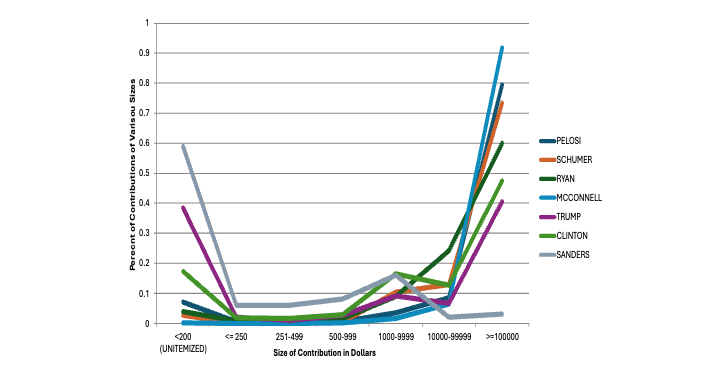
The first is adapted from an earlier paper three of us published some years ago. It tracks the real size distribution of political contributions to key political leaders during the 2016 election cycle. The totals add together contributions from the same donors that often individually look much smaller. The numbers differ drastically from foggy media headcounts of total donations by famous billionaires or horse race comparisons of campaign spending for many reasons beyond the famously elusive streams of “dark money.”
They are the closest thing available to an X-ray of the real dominance of big money in elections. As such, they virtually never appear in either social science discussions or the major media, which both lavish virtually all attention on polls.
Figure 1: Dominance of Big Money: Size of Contributions of American Political Leaders 2016 Cycle
Source: Adapted from Ferguson, Jorgensen and, Chen Structural Change and Economic Dynamics 2022
Each leader’s line has a color; the height of the left vertical line shows the percentage of contributions they received from donors of varying sizes running along the bottom axis.
The message – for 2016 – is stark. One candidate, Senator Bernie Sanders, raised virtually all his money from the two lowest bins – less than $200 and below $250.
By contrast, all the other leaders of both parties raised very high percentages of their funds from the top brackets. The then Congressional leaders of both parties – Senators Schumer and McConnell; Nancy Pelosi and Paul Ryan in the House – depended not on big, but giant donors – typically more than $100,000. So did both presidential candidates – Hillary Clinton and Donald Trump, with the very interesting twist that Trump also raised substantial sums from small donors (a unique “barbell” pattern).
We have used data from the Federal Election Commission to construct similar figures for the much-discussed Maine Senate race. Incumbent Senator Susan Collins is running on the Republican ticket, while Graham Platner is her Democratic challenger. Our totals reckon in contributions from Super Pacs and other outside organizations spending on behalf of either candidates or against one (which we count as spending for the candidate’s opponent).[1]
The figures for the Democratic candidate, Graham Platner, reflects contributions for his primary campaign this year. Susan Collins, the Republican incumbent, faced no primary opponent, but has been raising money at a brisk pace for the general election for a long time. Senators run for election only every six years and can spend money they have accumulated over time. We also believe that past contributions are often very revealing.
Our totals thus include contributions from her last run for office, in 2020. Putting together the full ensemble requires a substantial effort: This year seven different committees are raising and spending money on her behalf, along with seven more Super Pacs, which, so it is said, operate independently of her campaign. Some spend only against Platner; we count those, too.
Figure 2: Big Money in Maine Senate Elections
Source: Federal Election Commission Numbers, See Text
Platner, famously, forced out his opponent in the Democratic primary – the sitting governor of Maine – long before the primary, despite a series of controversies over his past.[2] Platner is strongly supported by Senator Bernie Sanders and other progressives, while many establishment Democrats dislike him. Major media keep printing articles questioning his character. By contrast, Collins’ somewhat contradictory legislative history attracts less coverage. Most discussions stop with the mantra that she cooperates more across party lines than virtually any other Republican Senator, with little regard for what the partisan lockstep that most Republican Senators now march in may mean for such statistics.
Our tabulations of the race show that Collins is much closer to a typical Republican pattern (or, to be fair, those of the Old Guard Democratic leaders in Figure 1) in a key respect: the size profile of her donors. We have run the numbers both for the money she received including the 2020 campaign and for 2026 alone. Their shape is virtually identical as Figure 2 shows.
The Republican Senator from Maine is hugely dependent on very large donors. By contrast, Platner strikingly resembles Sanders: he attracts essentially no big money. Recently the numbers of billionaires supporting the candidates has emerged as an issue. A very few have supported Platner with small sums. Almost a hundred (counting spouses) have made contributions of varying sizes to Collins. The overall configuration is as shown in Figure 2 and is perfectly obvious.
Our analysis also reveals something else. If you put aside contributions that are below the $200 threshold for disclosure, the percentage of money received from Maine donors differs sharply between the candidates. Senate elections have been nationalized for a long time. Contributions from Maine itself make up approximately 20% of all money for Platner; by contrast, Collins’ rate is slightly under 3%. (Not a misprint.) Her biggest contributors include a Who’s Who of prominent financiers in private equity and hedge funds, including Steve Schwarzman of BlackRock, Ken Griffin of Citadel, along with other well known Republican donors, including Larry Ellison of Oracle.
The outcome of the Maine Senate race may well decide the balance of power in the Senate, so it is reasonable to expect that a great deal more money to flood in. That could change the shape of the distributions, of course. Or it could confirm them. For now the conclusion has to be that the Maine election offers a striking window into the stakes in American politics: Not just the partisan split in the Senate, but different possible futures for the Democrats.
______
